How to spot a good watch.
Five things decide the quality of a watch: the movement, the crystal, the case, the water resistance and the finishing. This guide shows how to check each one yourself, with no watchmaker and no loupe. By the end you read any spec sheet like a pro, whatever the brand on the dial.
You spot a good watch by five points: the movement, the crystal, the case, the water resistance and the finishing. A good maker names each detail precisely: the caliber by name, the crystal by material and thickness, the steel grade (316L) and the test pressure (5 or 10 ATM). Where you find only adjectives, the substance is usually missing.
The 5 marks of a good watch.
You spot a good watch by five points: the movement, the crystal, the case, the water resistance and the finishing. What all five have in common is this: a good maker names every detail precisely and verifiably. The caliber has a name, the crystal a material, the steel a grade, the water resistance a number.
The reverse holds too. Where the spec sheet offers only adjectives ('robust', 'refined', 'scratch-resistant'), the substance behind them is usually missing. Nobody hides a sapphire crystal or a brand-name caliber by choice. What is good gets named. What is not named is, in case of doubt, the cheapest option the costing allowed.
| Point | How you recognize it | Quick test |
|---|---|---|
| Movement | The caliber is named, for example a Miyota quartz or a Seiko NH70 | Is a caliber name on the spec sheet? If not, ask |
| Crystal | Material named precisely: sapphire, mineral or acrylic, ideally with thickness | 'Scratch-resistant' with no material named is a warning sign |
| Case | Steel grade stated (316L), a finish mixing brushed and polished surfaces | Pick the watch up: solid steel has noticeable weight |
| Water resistance | A concrete ATM figure (3, 5, 10, 20 ATM) rather than a vague 'water-repellent' | No ATM figure? Then assume splash level only |
| Finishing | Clean hand edges, a crown with no play, an engraved caseback | Zoom in on the hands with your phone camera: edges sharp or ragged? |
The five points are deliberately brand-independent. They work on an $80 department-store watch just as well as on a four-figure classic. In the chapters that follow we take each point one at a time, with the numbers you need for the comparison.
The crystal: sapphire, mineral or just "scratch-resistant"?
The crystal is the part you look at most often and are most likely to damage. Door frames, desk edges, car keys in the same pocket: a watch you actually wear collects contacts. Whether the crystal survives them comes down to the material. Three are in the running.
| Criterion | Sapphire crystal | Mineral glass | Acrylic |
|---|---|---|---|
| Hardness | Mohs hardness 9, only diamond and a few materials are harder | Noticeably softer than sapphire | Soft, a plastic |
| Scratch resistance | Practically scratch-proof in daily use | Picks up visible scratches over the years | Scratches easily, but can be polished out |
| Break behavior | More brittle, can crack under a hard knock | A little more shatter-tolerant than sapphire | Very break-resistant, barely splinters |
| Typical price class | Mid-range to luxury, occasionally below | Entry to mid-range | Vintage models and very cheap watches |
For a watch meant to look good for years, sapphire crystal is the first choice. Mineral glass is no flaw, but a compromise the price has to justify. Acrylic has its place with vintage lovers who value the warm crystal and do not mind the occasional polish. How deep the crystal question really goes, from Mohs against Vickers to marketing terms like 'sapphire-coated', is laid out in our full guide to watch crystal types.
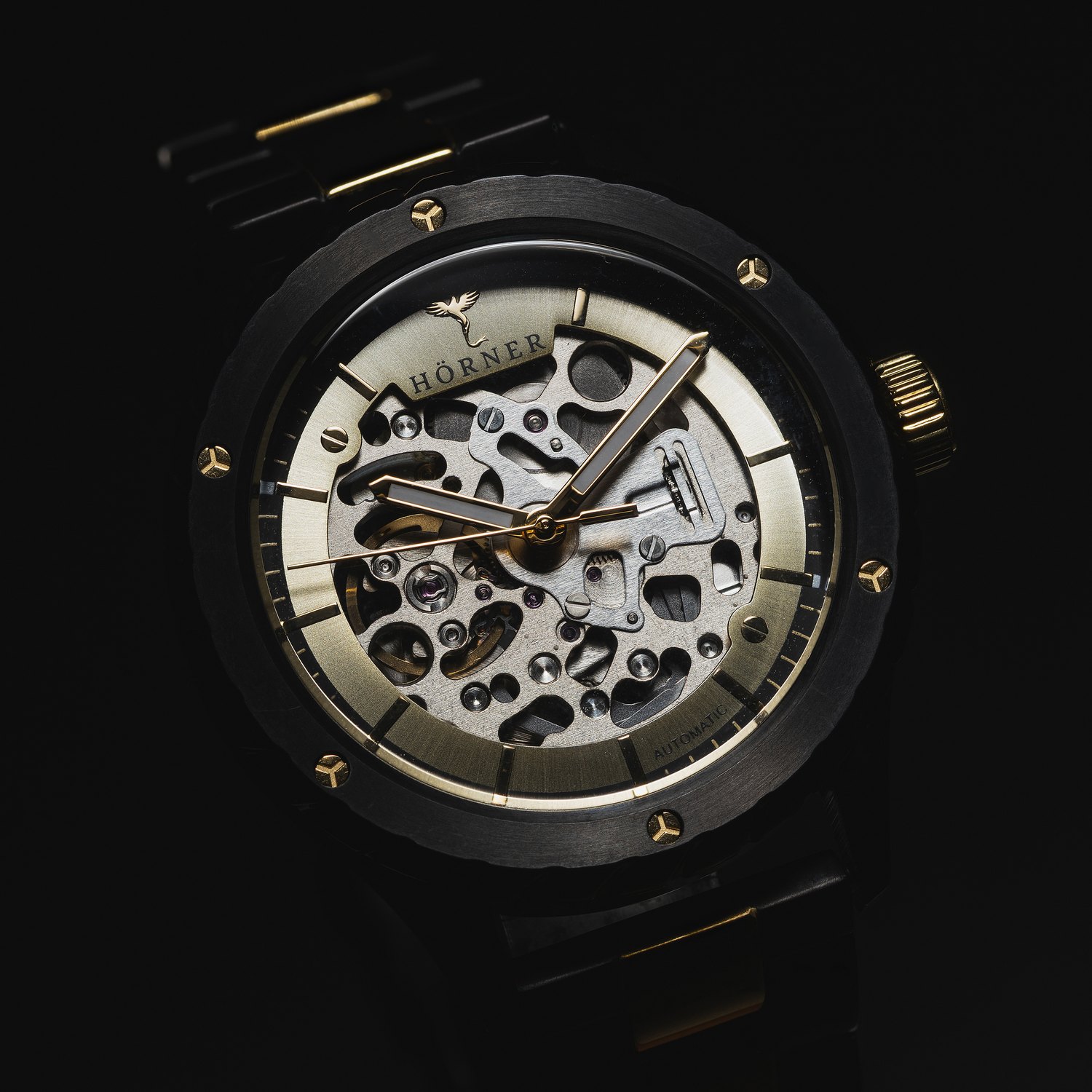
A look at our own range shows why the spec sheet is worth reading: the more affordable Nova (from $204) carries stated sapphire crystal, 2.5 mm thick and anti-reflective on both sides. The dearer Pulsar automatic carries hardened mineral glass, not sapphire. The Pulsar's premium sits in its skeletonized automatic movement, not in the crystal. That transparency is exactly the point: good makers name their crystal precisely, even when the answer is not 'sapphire' on every model. 'Scratch-resistant' with no material named, by contrast, is a signal to check, on any brand.
Reading water resistance: what 5 ATM really means.
Few figures are misread as often as water resistance. 5 ATM sounds like 50 meters of diving depth, but it means something else: the watch withstood a static test pressure of 5 bar in the lab. Still, at constant temperature, with no motion, as the watch standard ISO 22810 sets it out. On the wrist, arm movement, water temperature and soap are added, and they raise the load on the seals considerably. That is why the industry reads these figures conservatively.
| Rating | Splashes, handwashing | Showering | Swimming | Free diving |
|---|---|---|---|---|
| 3 ATM | Yes | No | No | No |
| 5 ATM | Yes | Borderline, better not | Not recommended | No |
| 10 ATM | Yes | Yes | Yes | No |
| 20 ATM | Yes | Yes | Yes | Only with an ISO 6425 diver's watch |
Two concrete examples from our range: the Nova is tested to 5 ATM, so it shrugs off rain, handwashing and splashes, but belongs on the shore before you swim. The Pulsar carries 10 ATM, so with it you can swim. Both are stated that way on the product pages, and that is exactly the quality benchmark: a concrete number rather than a vague 'water-repellent'. How much water each level really takes, and why heat is more dangerous to the seals than pressure, is shown in our guide on how water resistant a watch really is.
ATM is a lab test pressure, not a diving depth. A watch with 5 ATM is not built for 50 meters of water. Seals also age: if you regularly take your watch into water, have the resistance checked by a watchmaker now and then, above all after a battery change.
The case: 316L steel, finish and weight.
The case is the first thing you feel in the hand. Three things give its quality away: the steel grade, the finish and the weight.
The steel grade. The standard for a good watch case is 316L: a rustproof stainless steel nicknamed surgical steel for its use in medical technology. It is highly corrosion-resistant and releases very little nickel, so it is kinder to skin than simpler steels. If the spec sheet says only 'stainless steel' with no grade, or even 'metal alloy', that is no proof of poor quality, but a reason to ask.
The finish. Cheap cases are either fully polished or fully matte, because a single uniform finish costs the least to produce. A mix of brushed surfaces and polished edges takes extra steps and clean transitions. Where a brushed surface meets a polished one along a sharp line, someone put in the work. The Pulsar shows exactly this mix of brushed and polished surfaces.
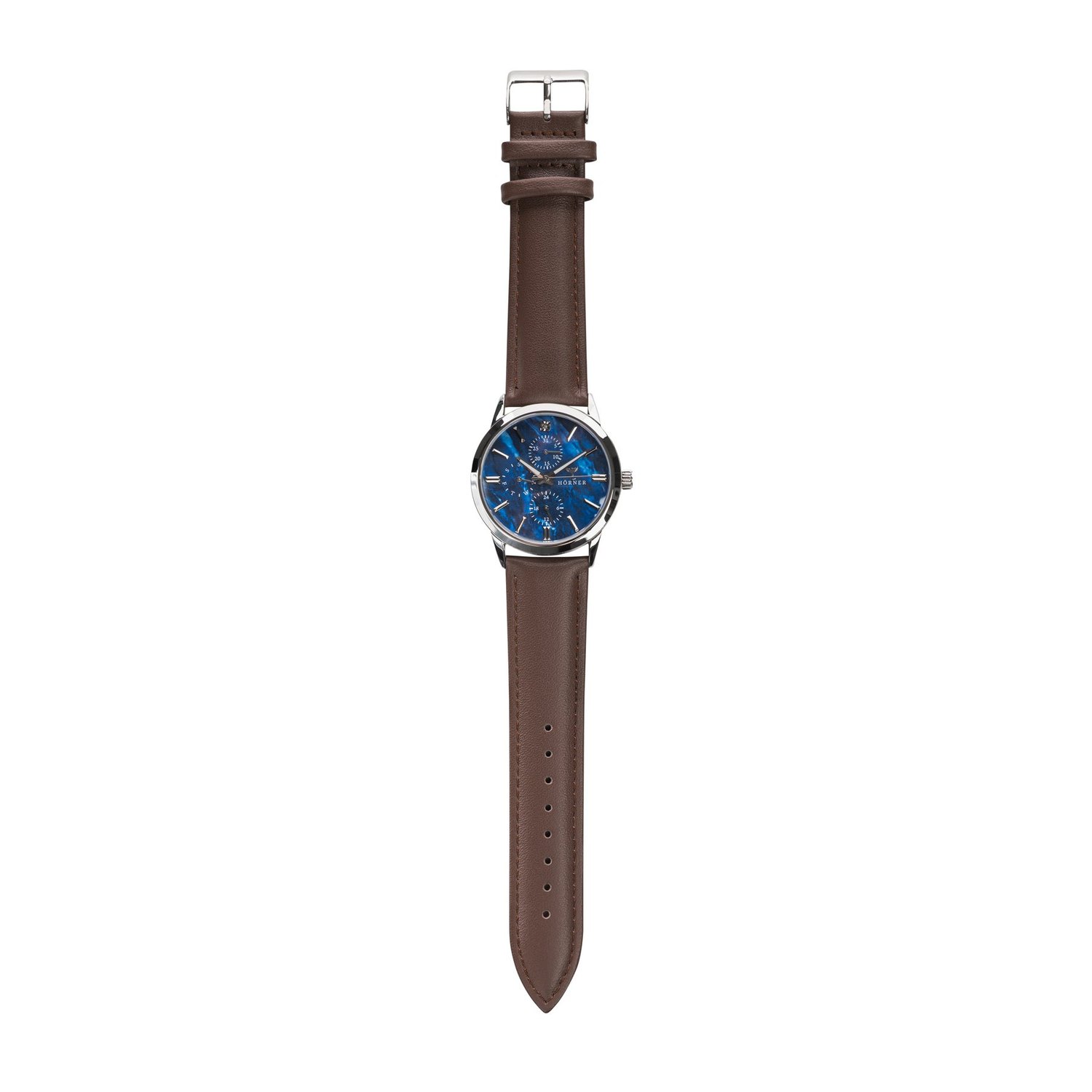
The weight. Solid steel has heft. The Nova, with its 40 mm case and leather strap, comes to around 100 grams; the Pulsar on its steel link bracelet, around 148. If a watch sold as solid steel feels suspiciously light, thin walls or other materials are often involved. Weight alone is no proof, but it is the most honest signal you can check without any tools.
One measurement often gets overlooked: lug-to-lug, the distance from one strap attachment to the other. It decides more than the case diameter whether a watch fits your wrist. The Nova measures 40 mm across and 47 mm lug-to-lug, so it sits well even on narrower wrists without overhanging. If you buy online, learn this figure and measure it against your own wrist, because a case can read small in millimeters yet overhang a narrow wrist through long lugs.
The movement: how to judge quality.
The movement is the heart of the watch, and this is where the quality check is easiest of all. You need no screwdriver, only a question: does the maker name the caliber?
Good makers do. In the Nova runs a Japanese Miyota quartz movement; in the Pulsar, a Seiko NH70 automatic. A maker who names the caliber lets you hold them to it: the technical data of these movements is public, every watchmaker knows them, and parts and service are no gamble. If the spec sheet says only 'high-quality quartz movement' or 'automatic movement' instead, you are buying an unknown. The movement may still be fine, but you cannot check it, and that is exactly what this kind of spec sheet counts on.
Two further signals can be read with the naked eye. First, skeletonization: on an open dial like the Pulsar's you watch the movement at work, including the swinging balance. A maker who shows the movement can afford to be seen. Second, functional value: a multi-eye display that puts date, weekday and a 24-hour readout onto small sub-dials is more than decoration. It shows the movement does more than hour and minute, and that the maker fitted a more complex caliber for it. If you want to see exactly what moves behind an open dial, our guide on the skeleton watch walks through it.
Whether quartz or automatic is the right technology for you is a separate question, and deliberately not this chapter's subject: both can be built superbly. Which movement suits you is settled in our honest comparison of automatic vs quartz watches.
Finishing in detail: hands, crown, caseback, strap.
Anyone can write a spec sheet. The finishing, by contrast, does not lie, and you can check it with the naked eye and two simple moves. Four places give away the most:
| Checkpoint | How to check | Good sign |
|---|---|---|
| Hands | Zoom in with your phone camera | Sharp, even edges with no burrs, cleanly set tips |
| Crown | Pull, turn, push it back in | Defined detents, no wobble, no play |
| Caseback | Turn it over and read the markings | Engraved rather than merely stamped or printed |
| Strap | Check the transitions and the clasp | Cleanly stitched leather or gap-free links, a clasp that closes precisely |
The caseback is the underrated one here, because almost nobody looks at it. That is exactly why it is where corners get cut first: a printed logo costs next to nothing, an engraving in metal costs a production step. On the Nova the phoenix and the technical markings are engraved into the caseback, not printed. That is not decoration for the display case; it is a hint about how the maker treats the places nobody inspects.
The strap says more than you would think too. A leather strap that tapers from the lug to the clasp follows the shape of the wrist and needs a more involved cut than a straight band; the Nova's Italian leather strap narrows from 22 to 20 mm for exactly that reason. On link bracelets, look at the clasp: a butterfly clasp like the Pulsar's all but disappears under the band when closed and shuts with a defined click. If a leather strap ever needs replacing, our guide on how to care for leather covers keeping it in shape.
And sometimes the care shows in a single detail: the Nova carries a diamond as the index at twelve o'clock. Functionally nobody needs that. But it shows someone thought beyond the minimum, and you almost never find such details on watches where the hands and crown were where the saving happened.
What the price really tells you.
Price is the weakest of the quality signals, and in both directions: cheap is rarely good, but expensive is not automatically better. An honest read of the price classes:
Under $100 gets you a working quartz watch, usually with mineral glass and a simple case. For the job of 'tell the time', perfectly fine. Sapphire crystal, named calibers and clean finishing are the exception in this class, and where they are promised, double-check.
$100 to $300 is the class where the price works most honestly. Here everything this guide is about becomes affordable: sapphire crystal, a 316L case, a named brand caliber, clean finishing. Every extra dollar in this class still visibly goes into material and production, because no large marketing machine is taking its cut.
$300 to $1,000 brings mechanical movements within reach, better finishing and more care in the details. At the same time, the share you pay for the name on the dial starts to grow noticeably. Two watches with nearly identical spec sheets can sit several hundred dollars apart in this class.
Above that you increasingly buy brand, history and prestige. That is legitimate; a watch is an emotional object too. You should only know that the material value no longer follows the price proportionally from here up. Whoever seeks substance compares spec sheets. Whoever seeks a status symbol compares names. Both are allowed; you should only know which of the two you are doing.
A $200 watch with sapphire crystal and a 316L case is built more solidly than many a $500 watch where the logo makes the premium. Ask to see the spec sheet, not the advertisement.Aus der Praxis · Andre Hörner
That is everything you need: five points, a few numbers and two simple moves. It takes no more than that to place any watch, in any price class, from any brand.