Automatic or quartz: which one is right for you?
Picture quartz and automatic like an electric car and a combustion engine: one precise and low-maintenance, the other a mechanical heart you can feel. There is no better or worse here, only two philosophies. Which one suits you comes down to a single question about what you want from a watch. This guide lays out both, honestly, and does not declare a winner.
The honest answer up front: neither is better than the other. A quartz watch runs on a battery-driven oscillating crystal, so it is very accurate, low-maintenance and never needs winding. An automatic carries a mechanical movement that winds itself as you wear it; it keeps time less precisely and wants a service every few years, but a real mechanical heart beats inside it. At the same price, quartz is the more accurate, more carefree watch. You buy an automatic for the feel and the craft, not for better timekeeping. The choice comes down to one question: do you want an effortless tool, or a piece of mechanics on your wrist?
Like an EV and a combustion engine: two paths, no winner.
The question of automatic versus quartz is often posed as if there were a right answer and a wrong one. There is not. The closest analogy is cars.
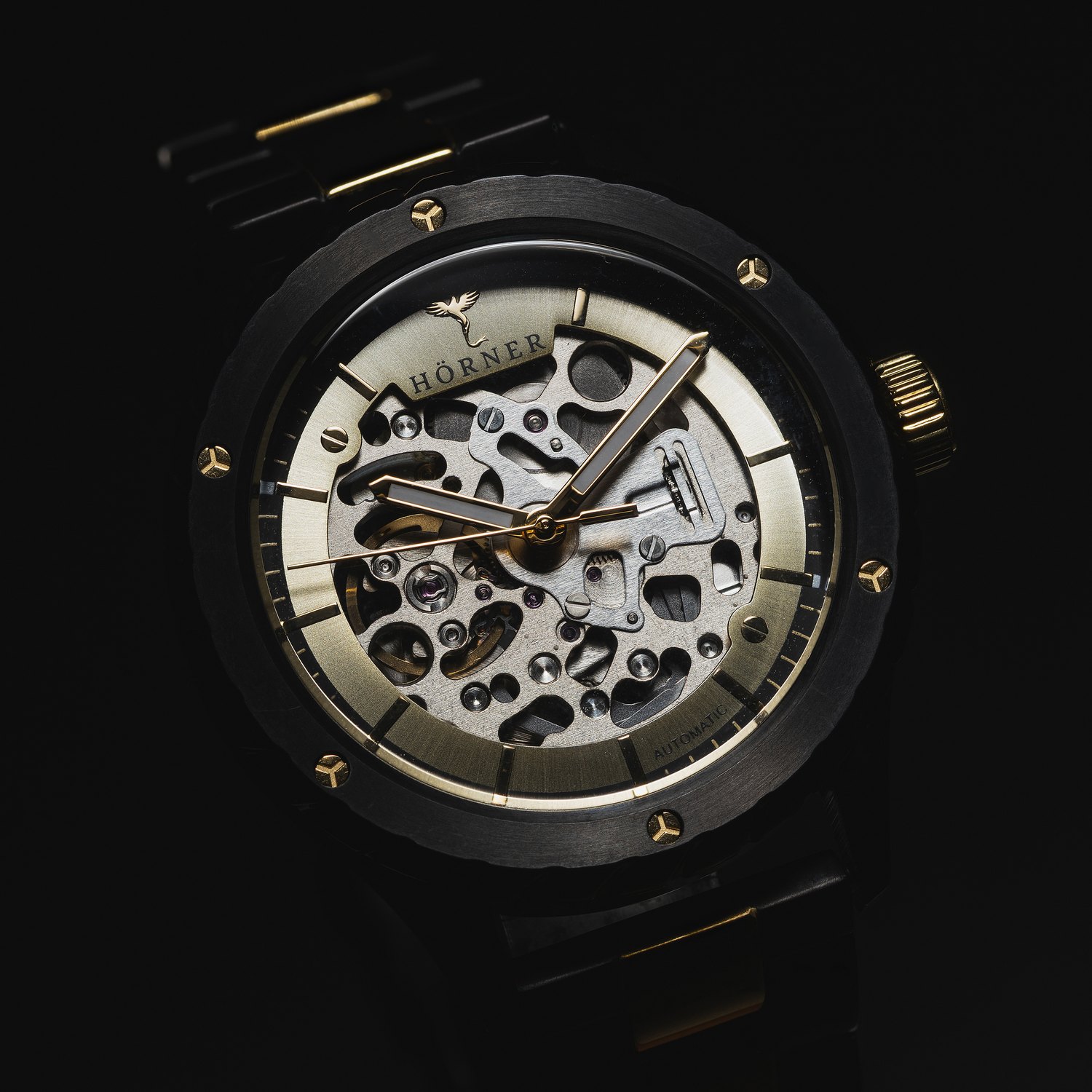
The quartz watch is the electric car: technically sober, very precise, effortless in daily life. You never wind it, it runs more accurately than almost any mechanical watch, and you barely think about it. The automatic is the combustion engine: a mechanical movement that lives off your motion, one you can hear, and through an open dial even watch at work. It asks for a little attention, and for many that is exactly the appeal.
No one would call an electric car the worse technology just because it makes no engine noise. In the same way a quartz watch is not inferior just because no gear train ticks inside it. It actually does its job better when the job is simply to show the correct time, reliably. The automatic is the more emotional, in a sense the more mature choice for someone to whom a watch means more than a timekeeper. Both are legitimate. This guide helps you work out which type you are.
How the two movements actually work.
The whole difference lives in how each movement is powered and kept in time. In plain terms, here is what happens inside each one.
The quartz watch. A small battery sends current through a tiny quartz crystal. It oscillates at a nominal 32,768 times per second, stable enough to keep the watch to roughly half a second to a second a day, with only small temperature and aging effects. A circuit counts those oscillations and drives the seconds hand from them. That is where the characteristic one-second jump comes from. This steady, high frequency is why quartz keeps such accurate time.
The automatic watch. Here no battery supplies the energy, a spring does. Inside, a small weight called the rotor turns as you wear the watch and tensions the mainspring with every movement of your wrist. The spring releases its force through a finely tuned gear train and a balance wheel that swings back and forth at high frequency, on many movements around 28,800 vibrations per hour. That is the source of the soft, gliding seconds hand. An automatic is the modern form of the mechanical watch: you never have to hand-wind it as long as you keep wearing it.
One common misconception, in passing: the faint ticking of a mechanical watch does not come from the seconds hand but from the escapement deep in the movement, which releases the energy in tiny portions. It is the sound of the mechanics at work. If that visible, working movement is what draws you in, our guide on what you actually see through an open dial walks through it station by station.
The honest side-by-side.
Many comparisons online lean on rounded or flattering figures. Here are the key points as ranges that actually occur in practice. The exact number always depends on the individual movement.
| Property | Quartz watch | Automatic watch |
|---|---|---|
| Accuracy | Very high, about ±15 sec per month | Noticeably lower, about ±5 to ±10 sec per day |
| Power source | Battery | Winds itself as you wear it |
| Reserve when off the wrist | Runs until the battery dies | Typically ~36 to 48 hrs |
| Seconds hand | Jumps in one-second steps | Glides smoothly across the dial |
| Upkeep | Battery change every 1 to 3 years | Service every ~3 to 5 (up to 10) years |
| Weight and height | Can be flatter and lighter | Usually a little heavier and taller |
| Sensitivity | Robust, unfussy | More sensitive to hard shocks and magnetism |
| Movement lifespan | Long-lasting, movement often a replaceable part | Decades with service, often passed on |
| Character | Precise, carefree tool | Living mechanics you can feel |
Do not read the table as a scorecard where one side wins. It shows two different promises. Quartz promises accuracy and freedom from fuss; automatic promises mechanics and character. Which promise means more to you is what the next two chapters settle.
When quartz is the smarter choice.
Quartz carries an unfair reputation as the cheaper option. For many people it is simply the more sensible one. A quartz watch is the right pick when you want to:
- have maximum accuracy. A drift of around fifteen seconds a month beats any normal automatic by a wide margin. If you never want to reset the watch, take quartz.
- own a low-maintenance everyday watch. Put it on and forget it. Beyond a battery change every few years, nothing happens. Ideal for the watch that just needs to work every day.
- travel a lot or wear the watch irregularly. Quartz does not stop just because it sits unworn and still shows the right time after weeks in a drawer. No power reserve to run down, no resetting.
- buy your first genuinely good watch. As an entry into a quality watch, say with a stainless steel case and a sapphire crystal, quartz gives you noticeably more material and finish for the money.
In short, quartz is no compromise. It is the more honest choice as soon as what you mostly want is a reliable, accurate and uncomplicated watch. Case and crystal matter here too; our guide on watch crystal types weighs sapphire against mineral and acrylic, and a quartz watch is often where a sapphire crystal earns its place.
When an automatic is the right one.
If quartz is the rational choice, the automatic is the emotional one. You do not buy it because it keeps better time, but because it can do something a quartz watch never will: live. An automatic is the right watch when you want to:
- love the mechanical. A movement of many small parts, fed by nothing but your motion, has a fascination no oscillating crystal can create. An open, skeletonized dial even makes that heart visible.
- wear the watch daily anyway. Wear it every day and the automatic keeps itself running, so you get the benefit without ever feeling the drawback of it stopping.
- seek an emotional value. A serviced mechanical movement runs for decades and can be handed on. An automatic becomes a companion with a history far more easily than a replaceable quartz movement.
- enjoy the calm, gliding seconds hand. For many, that smooth sweep is the loveliest detail on the wrist and the most visible difference from a quartz watch.
The automatic is the watch for someone to whom the how matters more than the how accurate. It asks for a little more attention and gives a piece of craft in return.
You buy an automatic not because it runs more accurately, but because a real mechanical heart beats inside it, and you can feel it live off your motion.On automatic watches
What it costs you over the years.
At purchase, the movement says less about the price than the case, crystal and brand do. Still, there is a rough orientation for what both worlds cost. The following ranges are generic market values, not a brand recommendation.
| Tier | Approximate range |
|---|---|
| A solid quartz watch to start | from about $35 |
| A quality quartz watch (steel, sapphire crystal) | about $90 to $340 |
| An entry-level automatic | about $170 to $550 |
| A higher-end mechanical watch | from about $900 upward |
More important than the purchase price are often the running costs, and here the picture reverses. A quartz watch costs almost nothing over the years: a battery change every one to three years, usually a small fee. An automatic wants a service every few years, which starts at a meaningful figure and can climb well higher on more complicated movements. That is no argument against the automatic, only the price of a mechanical movement that, cared for, runs for decades. Simply factor it in from the start.
Both movements span a huge range. There are excellent quartz watches costing five figures and modest automatics costing a fraction of that. The premium on an automatic buys mechanical craft and the experience of the movement, not more accurate hands. Choose the movement for the character you want, then let case, crystal and finish decide the rest.
Myths worth clearing up.
Stubborn half-truths cling to both movement types. Here are the most common ones, turned over so you can see what actually holds.
Myth: an automatic is more accurate because it is more expensive. The opposite is true. Quartz keeps far better time. The premium buys mechanics, not precision. If accuracy is your priority, a good quartz watch beats almost any automatic.
Myth: a quartz watch is inferior. No. Quartz is a different technology, not a lower grade. A good quartz watch is more accurate and more carefree than an automatic, and quartz watches exist at every price point.
Myth: you must wind an automatic every day. No. Worn regularly, it winds itself from your wrist and never needs winding by hand. Only after it has sat unworn past its power reserve does it stop, and then a few turns of the crown restart it.
Myth: a stopped automatic is damaged. No. Stopping harms nothing on a modern automatic. Wind it, set it, wear it. A pause is even good for the mechanics.
Myth: an automatic needs a watch winder. Not for a single watch you wear often. A winder is a convenience for collectors with several automatics, never a requirement.
Both worlds, if you want to make it concrete.
Because we could advise honestly above, we may briefly say where we stand ourselves: Hörner deliberately carries both movement types, both designed in Dresden.
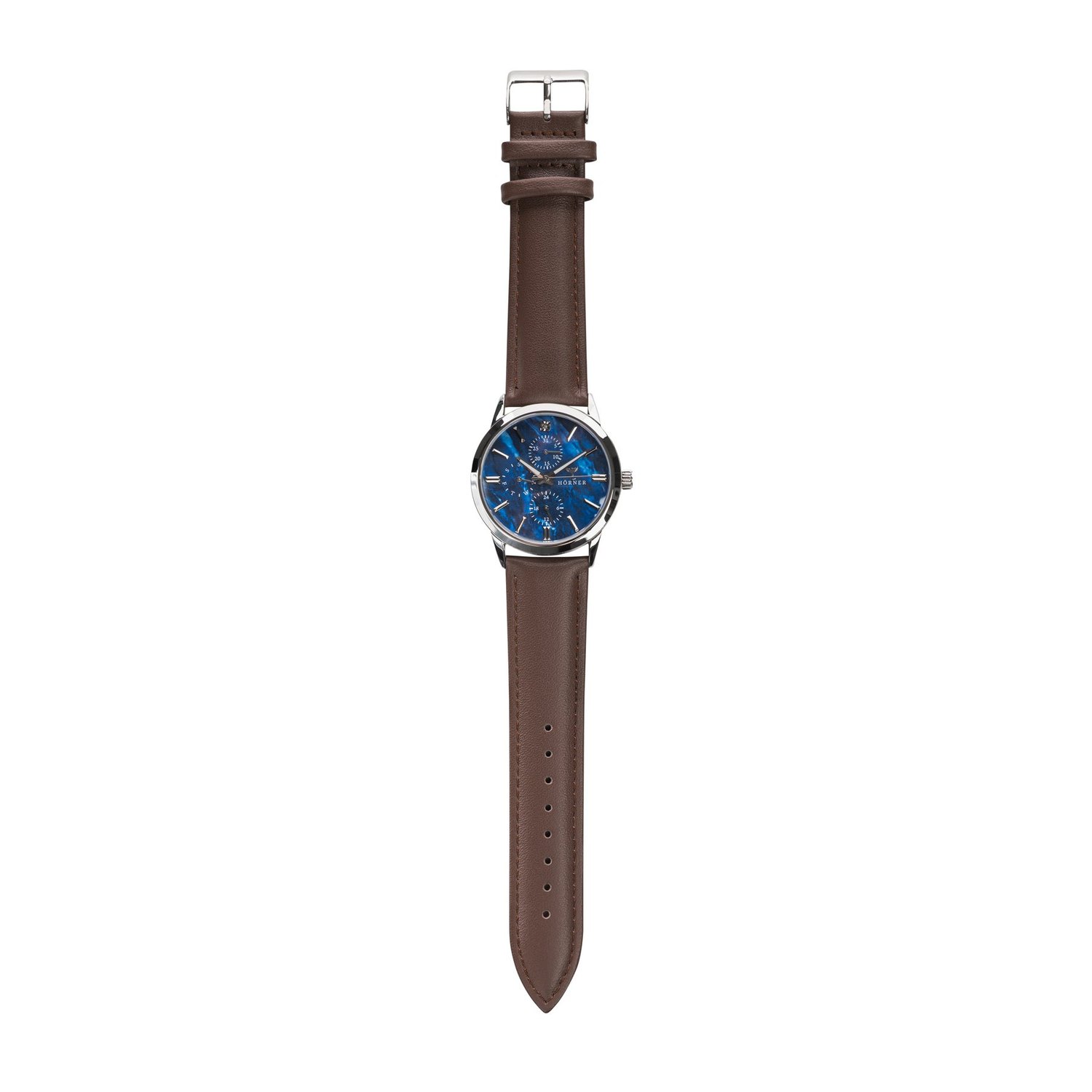
The Hörner Nova is the quartz side, with a Japanese Miyota movement, a sapphire crystal and a stainless steel case, from $204, exactly the precise, carefree everyday watch from the quartz chapter. The Pulsar is the automatic with a visible, skeletonized movement, from $334, the mechanical heart from the automatic chapter, protected by hardened mineral glass and rated 10 ATM. Which one suits you, you probably know better after this guide than any product page could tell you. Both arrive in a gift box; note that our watches cannot be engraved. The movement is only one of five marks of quality; our guide on how to spot a good watch runs through all five.
One last practical point that applies to both movements: whether you can swim with a watch depends on its water resistance, not on whether it is quartz or automatic. The Nova at 5 ATM handles splashes and rain, the Pulsar at 10 ATM goes further. Our guide on how water-resistant a watch really is explains what the ATM rating does and does not allow, so you match the watch to your daily life rather than to the movement type. Both watches ship with duties prepaid.