The skeleton watch, and what you actually see through an open dial.
Hold up a watch with an open dial and something tiny darts back and forth, exactly in time with the ticking. That is not a gimmick and not a battery. It is the balance wheel, the swinging heart of your watch. This guide walks through what an open dial really shows you, station by station, and cleanly separates the four terms people mix up: open-heart, skeleton, display caseback and tourbillon.
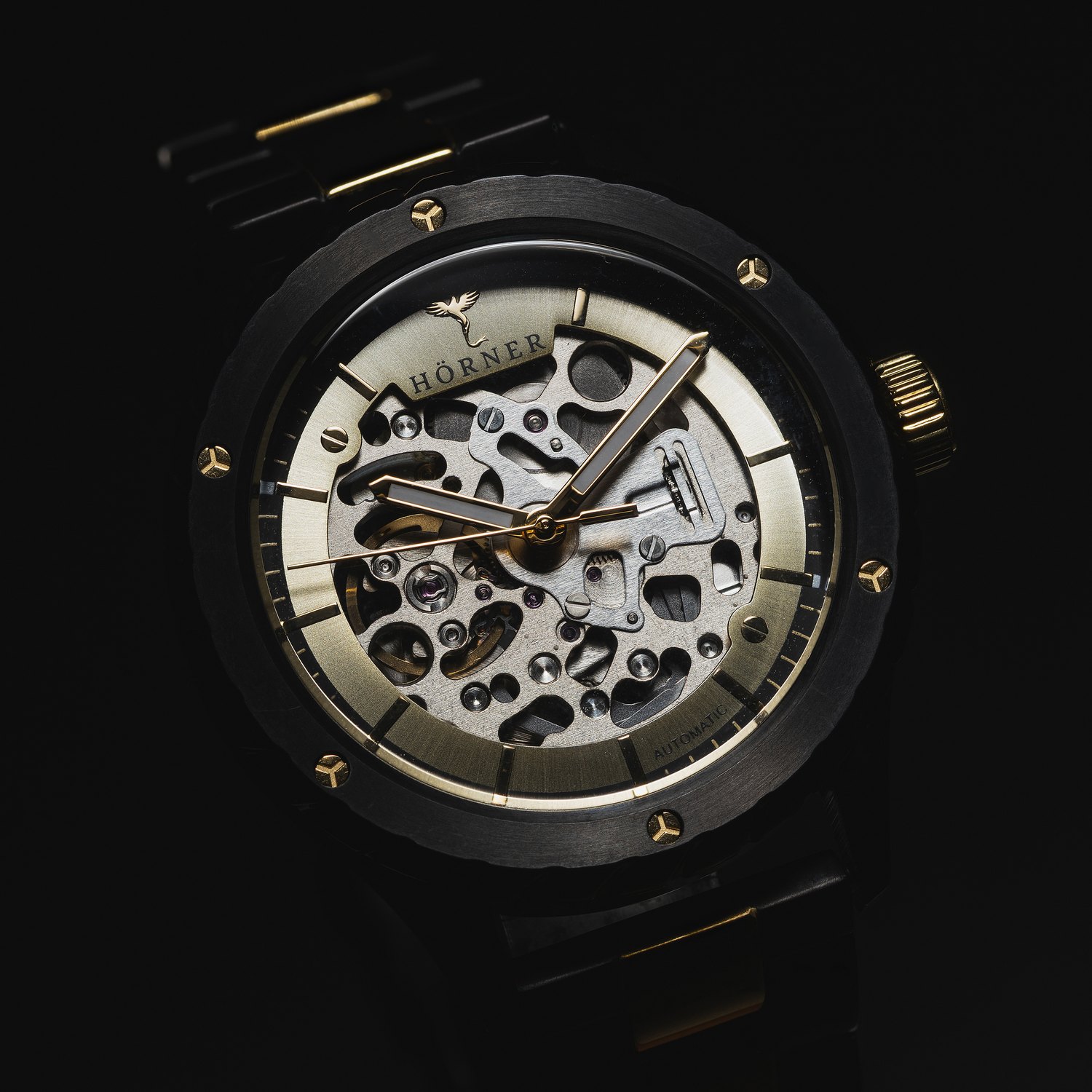
Through an open dial you see four things at work: the balance wheel swinging eight times a second, the lever pushing it in time, the hairspring coiling as it does, and on an automatic the rotor swinging with every movement of your wrist. Do not confuse the four terms: open-heart shows only the balance, a skeleton shows the whole movement from the front, a display caseback shows the movement from the back, and a tourbillon is a rotating cage with no accuracy benefit on the wrist. Visible mechanics is a promise of fascination, not of precision.
What you actually see through an open dial.
Hold a watch with an open dial to your ear and your eye at the same time. You hear the ticking, and in the same instant you see something tiny dart back and forth. Suddenly the sound and the motion line up. That moment of recognition is exactly why people want an open dial at all.
What is swinging there is the balance wheel, the timekeeper of the watch. But more than the balance moves in front of you. Look closely and four things run at once, and each tells part of the story of how your watch measures time.
- The balance wheel swings rhythmically back and forth, the most striking, almost breathing element. At 4 hertz it swings eight times a second, so fast the motion seems to shimmer.
- The lever, also called the pallet fork, flicks in the same beat. It is the small pivoting piece that gives the balance a push on each swing and makes the audible tick.
- The hairspring coils tighter with each swing and opens again, a fine breathing of hair-thin metal around the balance.
- The rotor swings on an automatic with every movement of your arm. It is the one part that reacts directly to you; on a skeleton dial you often glimpse it from the front, and most fully through a display caseback.
All of it runs in step with the ticking. Once you catch the rhythm, you are watching a watch keep time. The chapters that follow explain each station on its own, so the next time you look you know exactly what is in front of you.
How a watch ticks, in four stations.
Before we look at the balance in detail, it helps to see the whole. A mechanical watch is a closed loop of energy that is stored, slowed, portioned out and cut into equal beats. Four stations are enough to understand what you see through the glass.
First station, the energy store. The mainspring sits in the barrel. Winding it, by hand or through the rotor, tensions it. It wants to relax, and it supplies all the power the watch lives on, roughly a day or two on most automatics. On an automatic the rotor tops it up with each movement of the wrist.
Second station, the gear train. The spring's force runs through a chain of gears toward the escapement. Without a brake the spring would unwind in seconds and dump all its energy at once. Something has to divide the release into tiny, equal steps.
Third station, the escapement. Here is the heart. The lever escapement, in the vast majority of wristwatches the so-called Swiss lever escapement, is made up of the escape wheel and the lever with its two tiny ruby pallets, working together with the balance. On each swing the lever releases exactly one tooth of the escape wheel, the gear train steps forward, and in the same moment the lever gives the balance a push through the impulse jewel. That interplay is what you hear as ticking, and what you see through an open dial.
Fourth station, the timekeeper. The balance wheel with its hairspring sets the pace. The spring pulls the balance back to center after each swing, the way a spring returns a pendulum. How fast that happens depends on just two things, and those are the subject of the next chapter.
A watch does not measure time, it divides it. Into many equal, audible, visible portions.On mechanical watches
The balance wheel: the swinging heart of your watch.
The balance wheel is a small, pivoted wheel that does not spin round but swings: a little to the right, back again, a little to the left, on and on. What makes that possible is the hairspring, a hair-thin coiled spring that pulls the balance back to rest after each swing.
Together the wheel and spring form an oscillating system that runs remarkably evenly. The Dutch scholar Christiaan Huygens conceived this pairing back in 1675, and in principle it still works the same way today. The oscillator's frequency is mainly set by two things: how heavy the balance is, more precisely its moment of inertia, and how stiffly the hairspring pulls. Those two figures set the frequency at which the balance swings, and that frequency is given in vibrations per hour. Real-world accuracy then depends on more than frequency, as the accuracy section below explains.
In practice it is more vivid than it sounds. A very common modern figure is 28,800 vibrations per hour. That equals 4 hertz, or eight vibrations a second. That fast flicker is exactly what you see through an open dial. Older and many sporty movements run at 21,600 per hour, which is 3 hertz and six vibrations a second, visibly a little calmer. So-called high-beat movements reach 36,000, or 5 hertz.
| Vibrations per hour | Frequency | Per second | Typical of |
|---|---|---|---|
| 21,600 | 3 hertz | 6 vibrations | older and sporty movements |
| 28,800 | 4 hertz | 8 vibrations | the modern standard |
| 36,000 | 5 hertz | 10 vibrations | high-beat movements |
It is tempting to conclude that more is always better. It is not that simple. A higher frequency divides time more finely and offers more precision potential, but it costs more energy and speeds up wear, since every part works more often. A well-regulated 4 hertz movement runs as reliably in daily use as a high-beat one. For everyday accuracy what counts is clean regulation, not the raw beat rate.
Open-heart, skeleton, display caseback: the differences.
Four terms get mixed up around visible mechanics, and separating them lets you buy and judge watches with more confidence. They really mean different things, not gradations of the same thing.
Open-heart is the discreet view. A small window in the dial, usually at six or twelve o'clock, deliberately reveals only the balance wheel, the beating center of the watch. The rest of the dial stays closed and comfortably legible. You see the swinging heart and keep a classic watch.
A skeletonized dial is the full show. Here the dial is opened so far, and often material is removed from the bridges and the mainplate too, that large parts of the movement become visible from the front: gears, escapement, balance and often part of the rotor. Legibility deliberately steps back, and in exchange you see the mechanics in their full depth.
The display caseback, also called an exhibition back, is something else entirely: a transparent back. It shows the movement from behind, where the rotor swings on an automatic. The key point is that a display caseback is not a skeleton watch. Many watches with a fully closed dial still have a display back. Skeleton means a view from the front; display caseback means a view from the back.
And finally there is the tourbillon, often named in the same breath as the others, but it deserves its own chapter, because the most stubborn misunderstanding lives here. More on that in a moment. First, the direct comparison:
| View type | What you see | Direction | Legibility | Accuracy gain |
|---|---|---|---|---|
| Open-heart | Only the balance wheel, through a small window in an otherwise closed dial | From the front | Good | None |
| Skeleton | Large parts of the movement from the front: gear train, escapement and balance | From the front | Reduced | None |
| Display caseback | The movement from behind, usually the swinging rotor on an automatic | From the back | Full front dial | None |
| Tourbillon | A small rotating cage carrying the whole escapement and balance, turning slowly | From the front | Varies by model | None on the wrist |
Open-heart is the choice for anyone who wants to see the swinging heart yet still read the watch comfortably; the heart is in view and the watch stays a classic watch. The skeleton is for those who want to see as much working mechanics at once as possible; it is the maximum view, and legibility deliberately gives way. The display caseback suits anyone who wants to watch the rotor swing while keeping a classic dial up front; remember it is not a skeleton, it only shows the back. And the tourbillon is for collectors and lovers of visible watchmaking craft, fascinating to watch but no accuracy gain on the wrist.
A word on the effort behind a true skeletonization. Sawing out and decorating a complete movement by hand is specialist work that can take many dozen to over a hundred hours per piece. That belongs to high-priced haute horlogerie. Industrially open movements, such as the Seiko NH70 built into many affordable automatics, reach the open view a different way, without that handwork, and that is exactly what makes visible mechanics affordable in the first place.
Open-heart or tourbillon? An expensive mix-up.
An open-heart shows a fixed balance wheel through a window. A tourbillon, by contrast, is a small rotating cage that holds the entire escapement, balance included, and turns slowly. Visually it is captivating, which is exactly why it gets lumped in with an open-heart. Technically they are two different worlds.
The tourbillon was devised in 1795 to counter gravity in pocket watches. A pocket watch usually sits upright in a waistcoat, and in that one position gravity pulls on the balance the same way every time, which distorts the rate. The rotating cage averages that error out across all positions. On the wrist, though, your watch is constantly moving and changes position on its own. The original purpose largely falls away.
A tourbillon on the wrist is a showpiece of watchmaking craft, not an accuracy gain. Anyone chasing precision does not buy a visible cage.On tourbillons
This is not a put-down, just an honest placement. A tourbillon is proof of craftsmanship and, for collectors, a legitimate goal. No one should simply buy it believing the watch runs measurably more accurately for it. For everyday rate, clean regulation matters more than any rotating cage.
What the power reserve really tells you.
Many automatics carry a power reserve indicator, and it is often overrated. The power reserve is simply the time a fully wound watch keeps running with no further energy. On modern automatic movements it is usually between 36 and 48 hours, and some movements manage a good deal more.
Strictly, specialists distinguish the total running time from full wind and the reserve that remains beyond a normal 24 hours of use. In everyday talk the two are used almost interchangeably, and for you as a wearer the simple reading is enough: the indicator tells you how long the spring will keep going once you take the watch off.
The important point: the power reserve says nothing about accuracy. Whether there are ten hours or forty left in reserve, the balance swings on in the same beat. Only when the spring is right at the end of its force, and the balance swing drops noticeably, does the rate suffer. If you wear an automatic only occasionally, set it down fully wound or use a watch winder so it does not stop.
Accuracy, standards and what you may expect.
Here honesty pays off, because the finest visible mechanics change nothing about one physical fact: a mechanical watch is inherently less accurate than a quartz watch.
The balance and hairspring swing only conditionally evenly. The escapement intervenes, and centrifugal force, temperature, the position of the watch and even magnetic fields tug gently at it. A quartz watch, by contrast, is timed by an electrically driven crystal that oscillates far more stably.
In numbers, roughly: a quartz watch typically varies half a second to a second a day, a good mechanical movement more like five to ten seconds. Even an officially tested chronometer, meeting the strict ISO 3159 standard and certified by the Swiss COSC bureau, is allowed to run between minus four and plus six seconds a day. That is an excellent figure for a mechanical watch, and would be merely middling for a quartz one.
An open dial shows you that the balance is swinging, not how precisely it is regulated. Accuracy is created on the watchmaker's bench during regulation, not in the view through the glass. If you want maximum rate accuracy, a good quartz watch serves you better. If you want to see and feel the living mechanics, a visible movement is the deliberate, honest choice, trading a few seconds a day for fascination.
This placement takes nothing away from open mechanics. It only puts them in the right place. You buy a visible movement not because it runs more accurately, but because it is more beautiful to watch time pass, a deliberate, honest trade of a few seconds a day for the pleasure of the mechanics. If you are still weighing that trade in the first place, our guide on automatic vs quartz watches lays out both sides.
Who an open dial is really for.
That leaves the question of which view suits which person. The answer follows no ranking, only your taste and your daily life. The matrix below sorts the typical wishes.
| Your wish | Recommendation | Honest limitation |
|---|---|---|
| See only the swinging heart, read easily | Open-heart | Shows only the balance, not the whole movement |
| See as much mechanics as possible from the front | Skeletonized dial | Legibility steps back |
| Above all watch the rotor swing | Display caseback | The front dial stays classically closed |
| Wear daily, including sport and dust | Closed or a rugged model | Open areas make dirt show more |
| Maximum rate accuracy | Quartz or a chronometer | Visible mechanics is no accuracy advantage |
A word on care, which counts especially with open dials. A well-built skeleton watch does not have to be more fragile than a closed one; built right, it passes the same shock tests. Their real sensitivity is different: dust shows more on the open areas, and if you wear the watch daily you should take the usual four-to-five-year service interval seriously. Then the view into the movement stays clear, and the open dial keeps looking the way it did on day one. Water is the other thing to keep out; our guide on how water resistant a watch really is explains what the ATM rating does and does not promise.
How this translates in practice shows in our own watches, because Hörner deliberately carries both worlds. The Pulsar, designed in Dresden, is the automatic with visible mechanics. It carries a Japanese NH70 automatic movement with a skeletonized dial, through which you see the swinging balance and parts of the movement from the front, plus a stainless steel case, hardened mineral glass and 10 ATM. So the movements described in this guide can be watched on a real, affordable example. The honest counterpart is the Nova: a Japanese quartz movement, a closed dial with no visible balance, but sapphire glass and 5 ATM. Anyone who wants the quiet, very accurate, low-maintenance watch is right there; anyone who wants the living mechanics, with the Pulsar. That choice is exactly what this guide is about. If the two glasses raise a question of their own, our guide on watch crystal types weighs sapphire against mineral and acrylic. And the open movement is just one thing to judge; our guide on how to spot a good watch covers the five marks of quality end to end.