How water resistant is a watch really? What 3, 5 and 10 ATM mean.
50 meters does not mean 50 meters of diving, and swimming strokes do not destroy a seal. This guide translates the ATM rating into clear everyday practice, works the water pressure through the math so you can follow it, and names the danger that is bigger than any pressure in the water: heat, soap, and seals that quietly age.
The ATM or bar figure on a watch is a static lab test pressure, not a diving depth. 3 ATM means splashes, 5 ATM a brief dip, and from 10 ATM you can swim. Swimming strokes make only about 0.005 bar and are harmless. The real dangers are heat, aged seals and an open crown, not water pressure. And the crystal, sapphire or mineral, does not seal the watch; the gasket at its edge does.
What water resistance really means.
Few figures on a watch are as widely misread as its water resistance. "50 meters" sounds like a clear promise, but it is not one. Strictly speaking, a watch is not even allowed to be called "waterproof," because no watch is absolutely sealed.
The correct term is "water resistant." The word "waterproof" is not used for watches because it implies a certainty that does not exist. Every gasket has limits, and those limits change over time. Water resistance is always a snapshot of a new, intact watch, never a permanent state you can count on for the life of the piece.
This guide goes deep: the physics, the standards, the constant mix-up with IP protection codes, and the honest question of what you may actually do at each rating. The short table below is the answer at a glance; the chapters that follow explain the why, so you can judge your own watch with confidence rather than guesswork.
| Rating | Reads as | Safe for |
|---|---|---|
| 3 ATM | 30 m / 100 ft | Splashes and rain only |
| 5 ATM | 50 m / 165 ft | Handwashing, a brief cold dip |
| 10 ATM | 100 m / 330 ft | Swimming and surface snorkeling |
| 20 ATM | 200 m / 660 ft | Serious water sport, diver's models |
Reading ATM, bar and meters correctly.
On the dial or the caseback you often see "WR50," "5 bar" or "5 ATM." They all mean the same thing. ATM stands for atmosphere, and for everyday watch use ATM and bar are practically identical: one ATM equals 1.01325 bar.
The meter figure is just a conversion of that test pressure. The familiar rule of thumb, one bar equals ten meters, is an approximation rather than an exact value. Precisely it is about 10.2 meters at four degrees Celsius, and salt water differs slightly because it is denser than fresh water. In feet, 5 ATM works out to roughly 165 feet, 10 ATM to about 330 feet. For practice the rounded ten is fine. What matters is only this: the meter number is a pressure value, not an experience value.
And here is where most of the misunderstanding begins. The meter figure describes a static test pressure under lab conditions. "50 meters" does not mean "50 meters of diving." It means a new watch withstood a water pressure equal to a still column of water 50 meters deep. Why that number has to be read more cautiously in daily life is the subject of the next chapters.
The swimming-pressure myth, done by the math.
You have surely heard the claim: "You must not swim with a 5 ATM watch, because the arm movements raise the pressure enormously." It is the most stubborn myth about water-resistant watches, and a single formula puts it to rest.
The pressure that motion creates in water is called dynamic pressure. You calculate it with q = ½ · ρ · v². Here ρ is the density of water, about 1000 kilograms per cubic meter, and v is the speed. Put in realistic values:
- An arm moving at 1 m/s: q = 0.5 · 1000 · 1² = 500 pascal, about 0.005 bar or five centimeters of water column.
- Athletic swimming at 1.5 m/s: q ≈ 1125 pascal, about 0.011 bar or eleven centimeters.
- A completely unrealistic 10 m/s: q = 50,000 pascal = 0.5 bar, about five meters.
Now the comparison: a 5 ATM watch is rated for five bar of test pressure. The 0.005 bar from a normal arm stroke is roughly one thousandth of that. Even the absurd ten-meters-per-second case, at 0.5 bar, stays far below the test pressure. Motion in the water, in other words, is not the problem.
Watches do not drown from water pressure. They drown from heat, age and an open crown.On water resistance
And yet you still must not read the meter figure as a diving depth. The reason is simply a different one than usually claimed. It is not the motion, but the fact that the test measures a new watch under ideal conditions, that real seals age, that heat is added, and that soap and chemistry change the picture. The meter figure is a lab best case, not a promise for daily life.
IP68, IPX7 and smartwatches are not an ATM rating.
Smartwatches muddy the water, because they often use a different protection system. Classic watches are rated in bar or ATM, that is, by pressure. Many electronic devices instead carry an IP code to the standard IEC 60529.
In these IP codes the first digit is dust protection, the second is water protection. IPX7 means 30 minutes in one meter of water; IP68 means protection during continued submersion per the maker's spec. That is a completely different test from the static overpressure test in bar. The two systems do not convert into each other: IP68 is not "more than 10 ATM," and 5 ATM is not "IPX8."
Smartwatches like the Apple Watch or Garmin models often list both, an IP code and a pressure figure. An Apple Watch, for example, is rated "WR50," meaning five ATM to the standard. That allows shallow swimming, but the makers explicitly rule out diving, sauna and high-pressure water sport unless the device is certified to a diving standard. Treat a 5 ATM smartwatch exactly like a 5 ATM analog watch.
One more important distinction that is often missing: snorkeling at the surface creates barely more than the dynamic pressure we just calculated. But the moment you dive down, in free diving for instance, the static pressure rises with depth. Just three meters adds about 0.3 bar, ten meters about one bar. Those pressure spikes at depth, not the swimming motion, are exactly why repeated descents call for at least 10 ATM and, better still, a real diver's watch.
3, 5, 10 and 20 ATM in plain terms.
The matrix below sorts what the common ratings allow. It holds for a new, serviced watch. With old or untested watches, drop one level to be safe.
| Activity | 3 ATM | 5 ATM | 10 ATM | 20 ATM |
|---|---|---|---|---|
| Handwashing, rain, splashes (cold) | Yes | Yes | Yes | Yes |
| Bathing, showering (cold, no soap on crown) | No | Carefully | Yes | Yes |
| Swimming (pool, lake, surface) | No | Rather not | Yes | Yes |
| Snorkeling at the surface | No | No | Yes | Yes |
| Free diving, repeated descents | No | No | Borderline | Yes |
| Scuba diving with compressed air | No | No | No | Only if ISO 6425 diver's watch |
| Sauna, hot tub, hot shower | No | No | No | No |
The last row holds across every rating: heat beats pressure. No bar figure protects against a sauna or a hot tub. Why that is so is the subject of the chapter on real dangers below. And for scuba diving a high meter number is not enough either; that calls for a purpose-tested diver's watch, more on which in the standards chapter.
What 5 and 10 ATM actually allow.
Five and ten ATM are the two ratings that count for the vast majority of watches in everyday life. The gap between them is smaller than the doubled number suggests, and yet it marks a clear boundary.
5 ATM (50 meters / 165 feet). This is the everyday class. Handwashing, rain, a splash at the sink, a brief dip in cold water, a 5 ATM watch takes all of it in stride. What it is not is a swim watch. Not because of motion pressure, which stays tiny by the math above, but because the safety margin for continued, repeated contact is missing, and warm water plus aging tax the seal faster.
10 ATM (100 meters / 330 feet). Here the swim-and-snorkel class begins. A serviced 10 ATM watch comes with you to the pool, the lake and the surface while snorkeling. The jump from five to ten ATM is practically the move from "water-tough in daily life" to "swim capable." What 10 ATM does not cover is real scuba diving with compressed air, and anything involving heat.
Three quick habits protect more than any meter number on the caseback. First, push the crown fully in or screw it down, and never operate it underwater. Second, no hot water and no sauna. Third, after salt or chlorinated water, rinse briefly with clean fresh water. None of it is a rule from the manual, just lived care that keeps the watch worth keeping.
The real dangers: heat and thermal shock.
If neither pressure nor motion is decisive, what does put a watch at risk? In workshop practice the answer is almost always the same: heat and thermal shock. A sauna reaches 70 to 100 degrees Celsius, a hot tub about 40. The seals of many everyday watches are not built for such temperatures over the long run; for scale, the central standard tests at around 40 degrees.
The real harm comes from the fast swing from hot to cold. The air in the case expands and then contracts, and it is exactly that swing that works against the seal, not against the crystal. You see the result as fog or condensation under the glass. A hot shower right after a cold pool is therefore riskier than the swimming itself.
Soap and surfactants are among the quiet risks too. They lower the surface tension of water and can help it slip past aged seals, especially under warm water. This is not formally proven or standardized, so it counts as a cautious recommendation: keep soap away from the crown. Salt and chlorinated water, meanwhile, do not destroy stainless steel overnight; a brief rinse with fresh water is prevention, not an emergency.
Fogged from the inside, what to do now.
Fog on the inside of the crystal is the clearest warning that moisture or moist air is sitting in the case. Usually there is no diving accident behind it, but a temperature change: warm, slightly damp air in the case condenses the moment the crystal cools.
Here is how to handle it. Pull the crown so the case can breathe, and set the watch crystal-down for a few hours in a warm, dry place. Not on a radiator and not with a hairdryer, since that would be another thermal shock. If the fog clears, it was residual moisture. If instead a droplet forms or the fog stays, the seal is leaking, and the watch belongs with a watchmaker without delay before the moisture attacks the movement. Home remedies like rice do not fix a seal problem.
Seals, the crown and what you should know.
Water resistance is not a state a watch keeps for life. It rides on a few small, unremarkable parts that age. Understand that and you judge the risk correctly.
- Seals age, even unworn. The gasket rubber turns brittle over the years through heat and oxidation and loses its elasticity, whether or not the watch is worn. As a rule of thumb: inspection every two to five years, yearly with regular water contact.
- Four points age independently. The caseback, the crystal edge, the crown tube and, if fitted, the pushers of a chronograph are separate sealing zones. One can fail while the others hold.
- Quartz watches carry an extra risk. Every battery change opens the caseback. Always have the water resistance checked again afterward.
- The crown is the most common weak point. A crown left unclosed or closed wrong is, in workshop practice, the most common entry point for water. A screw-down crown adds protection, but only when it is fully screwed shut.
Water resistance can only be judged reliably by a professional test. The watchmaker uses two methods: the dry air-pressure or vacuum test, which measures the case for tiny deformation without water, and the wet pressure test. A pure check usually falls in the low double-digit dollar range, while an added seal replacement costs more depending on the model. Your own eyes help for orientation too: fog under the crystal, a visibly cracked gasket at a caseback change, or a wobbly crown are clear signals that a test is due.
ISO 22810, ISO 6425 and old watches with no rating.
Behind the bar figure stand standards, and two of them are worth knowing, because they explain the difference between a sport watch and a real diver's watch.
ISO 22810 for sport and everyday watches. Testing is done on a sample batch, not every watch. Among other things a watch runs through an overpressure test and a temperature-cycle test, placed in turn in water of about 40 degrees, then 20, then 40 again, followed by a condensation check. Both the overpressure and the temperature-cycle test decide pass or fail, and neither of them is a diving-depth rating.
ISO 6425 for diver's watches. Here every single watch is tested, at 125 percent of the stated rated depth, plus a 24-hour salt-water test and thermal-shock, magnetic-field, impact and legibility tests. Only a watch that passes may carry the "Diver's Watch" designation. That is why a genuine diver's watch is more than a high meter number on the caseback.
A practical special case is old watches and heirlooms. If a watch has no legible rating or none at all, treat it as not water resistant until a watchmaker confirms otherwise. The original rating is often not comparable to today's standard, and after decades the seals have very likely hardened. So before the first water contact, go to a specialist, renew the seals, have it tested, and when in doubt wear it dry. If you are also weighing whether a mechanical or a battery movement suits you, our guide on automatic vs quartz watches works that choice through.
Water resistance in the Nova and Pulsar.
How the two everyday classes feel in practice shows in our own watches, designed in Dresden. Each stands for one of the two ratings that matter most from the chapter above.
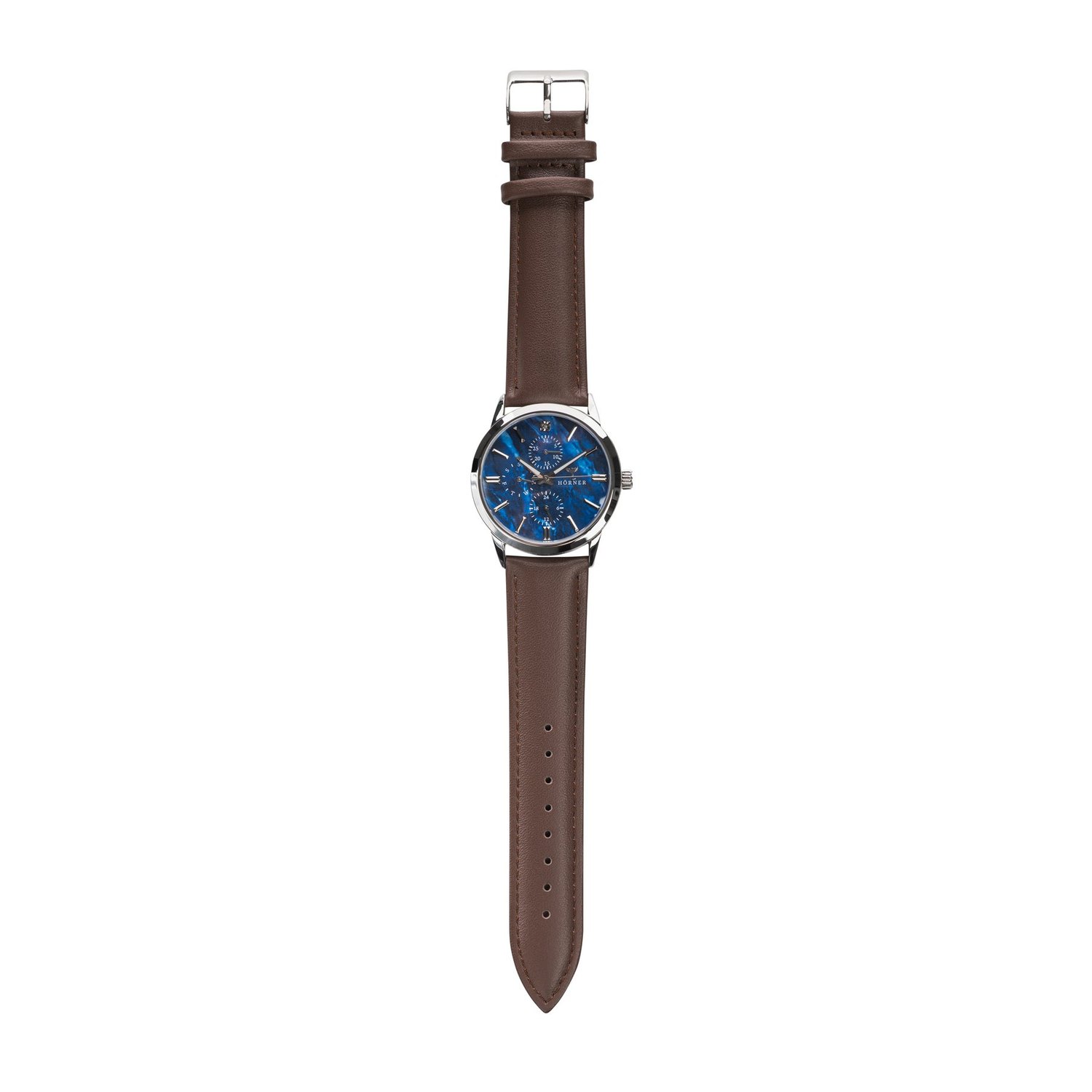
The Hörner Nova carries 5 ATM, a Miyota quartz movement and an anti-reflective sapphire crystal in a stainless steel case, from $204. What 5 ATM covers by the standard is clearly bounded: everyday wear, handwashing, rain, a brief dip in cold water. It is not built for regular swimming, snorkeling or the sauna. As a quartz watch it benefits from having the seal checked at the same time as the battery change.
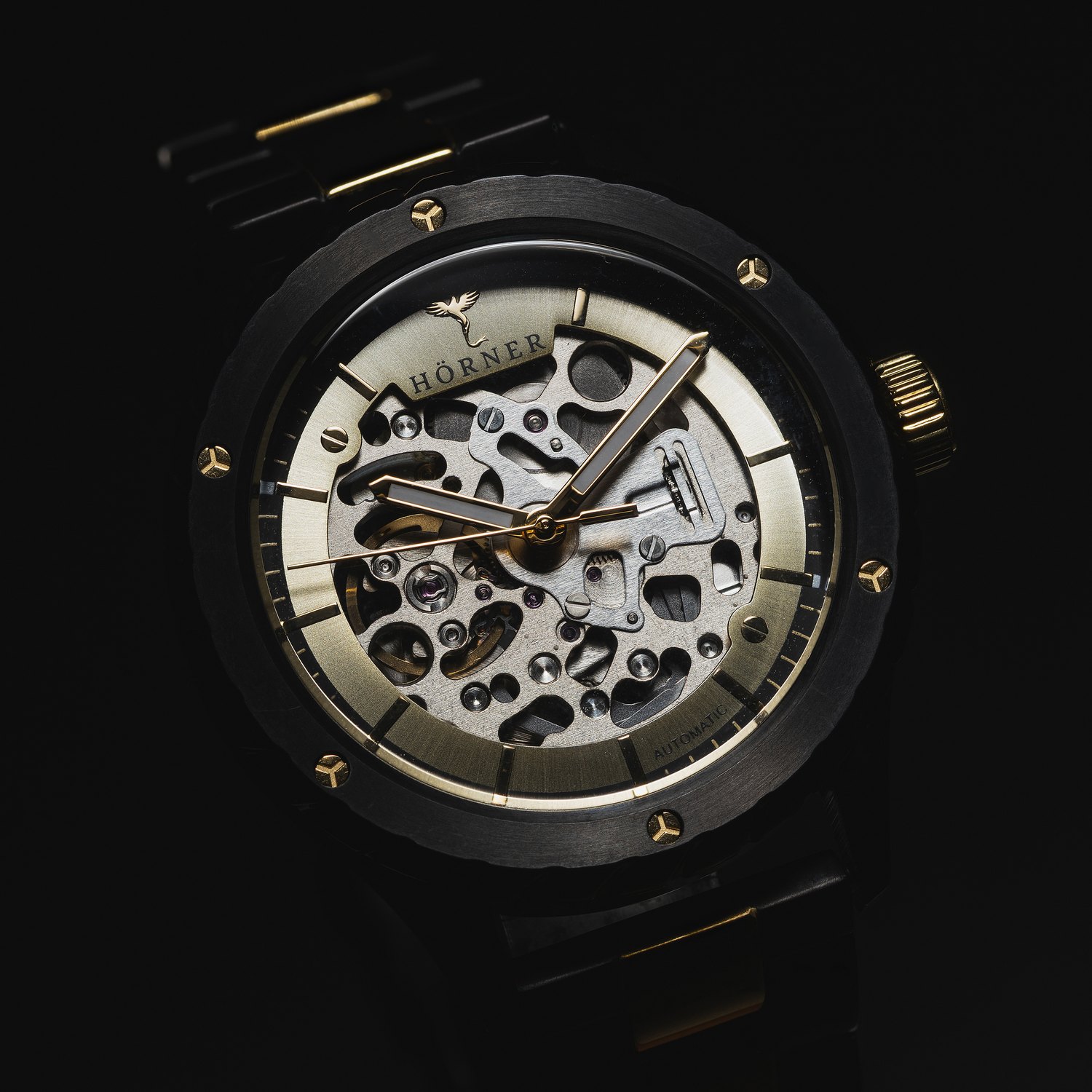
The Pulsar carries 10 ATM, a Japanese NH70 automatic movement and hardened mineral glass in a stainless steel case, from $334. The 10 ATM class, given an intact and serviced seal, is cleared by the standard for cold showering and surface swimming. It is not built for scuba diving with compressed air, which needs a diver's watch to ISO 6425, and not for the sauna or a hot tub.
The step from the Nova to the Pulsar maps exactly the transition this guide is about: from water-tough in daily life to swim capable. Neither is a diver's watch, and no meter number replaces a serviced seal. If you are weighing a mechanical movement against quartz, our guide on automatic vs quartz watches helps. And why one wears hardened mineral glass and the other sapphire, that is, which watch crystal is right, is settled in our guide on watch crystal types. If you like the idea of watching the movement work behind that glass, see what an open dial really shows you. And for the full picture, water resistance is one of five marks of quality in our guide on how to spot a good watch.