The grades of leather, and which one to trust.
Full-grain, top-grain, genuine, bonded: the words on a leather label promise a lot and define almost nothing. Most of them are not regulated, and the most reassuring-sounding one, 'genuine leather', is near the bottom of the pile. Here is what each grade really is, how a hide becomes leather, and how to tell good leather from the rest before you buy.
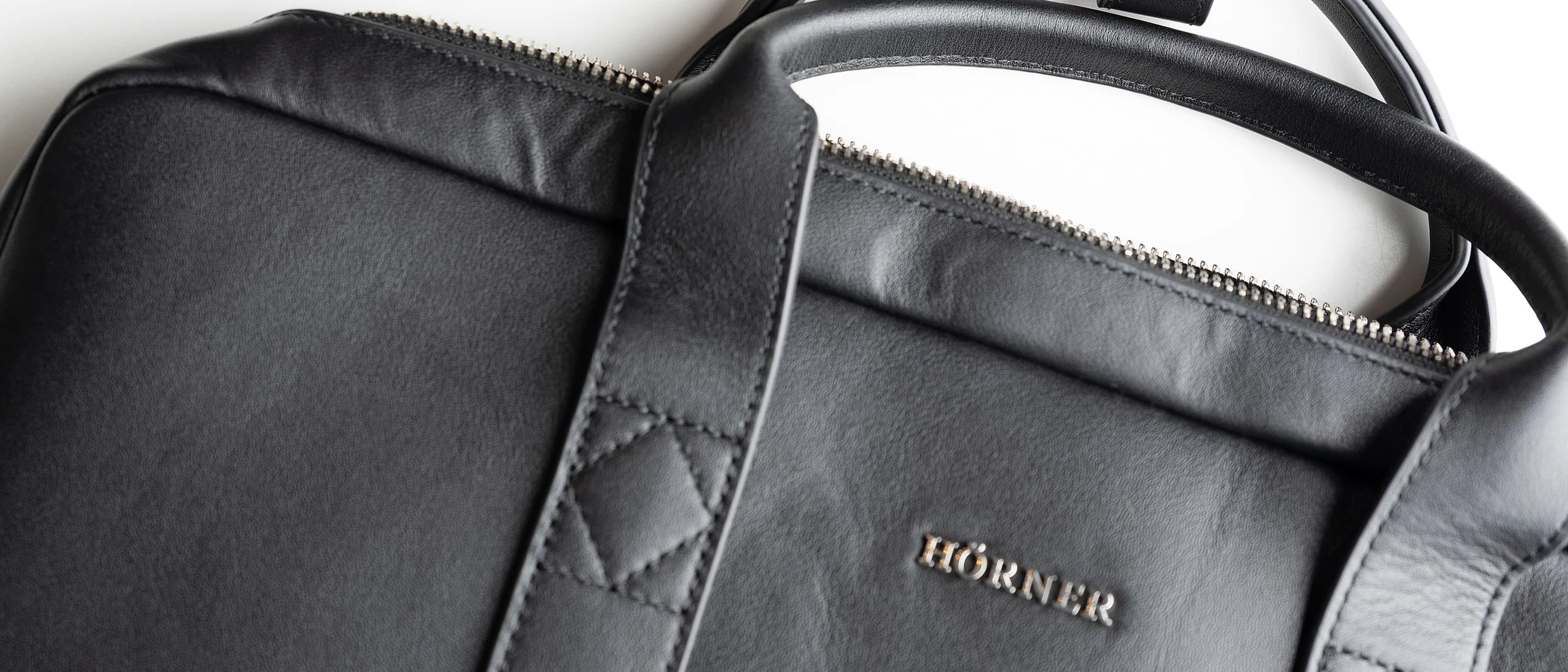
Leather is graded by how much of the hide's natural grain survives. Full-grain keeps the grain completely intact and is the strongest, longest-lasting grade. Top-grain is lightly sanded and sealed, cleaner but a step down. Corrected grain is heavily sanded with a fake grain stamped on. Split leather is the lower layer with no natural grain, fine for suede but weaker. Bonded leather is glued scraps and barely leather at all. The label "genuine leather" tells you only that it is animal hide, nothing about quality. Buy on the grade that is named, not on the nicest-sounding word.
How leather is actually graded.
There is one idea behind every leather grade, and once you have it the rest falls into place: leather is ranked by how much of the hide's natural surface, the grain, is still there.
The grain is the outer layer of the skin, where the fibers are densest and strongest. The more of it a leather keeps untouched, the better and more durable it is. So the hierarchy runs from full-grain, where nothing is removed, down through top-grain and corrected grain, where the surface is progressively sanded and rebuilt, to split leather, which has no natural grain at all, and finally bonded leather, which is leather scraps glued back together.
This ranking is an industry frame of reference, not a single binding standard, and a great top-grain from an excellent tannery can beat a mediocre full-grain. But as a way to read a label and know roughly what you are getting, it is the most useful thing to understand. The rest of this guide walks each grade in turn.
From hide to leather: the cut that decides everything.
A raw cowhide is around four to five millimeters thick. That is far too thick and stiff to sew into a wallet or a bag, so the tannery splits it horizontally into layers, and that single cut sets up the whole grading system.
The upper layer carries the hair side and the natural grain. Here the collagen fibers are densest and cross in every direction, which makes this layer the strongest, the most dimensionally stable, and the most valuable. The lower layer, the flesh split, has looser, more open fibers and no natural grain. It is rougher on both sides and tears far more easily.
Everything that follows, full-grain through to split, is really a question of which layer you started from and how much of that prized top surface was kept or sanded away. The layer thickness is measured precisely during processing, to a recognized standard (DIN EN ISO 2589), which is why a maker who knows their material can tell you the exact thickness of the leather on a folder or wallet.
One cut through the hide decides almost everything. Keep the grain and you have the best leather there is. Sand it off, and you are working your way down the list.On how leather is graded
Full-grain: the top of the tree.
Full-grain is the highest grade, and the definition is refreshingly simple: the natural grain layer is left completely intact, with nothing sanded or buffed off the surface.
Because the surface is untouched, full-grain keeps the densest fibers in the hide, which is exactly what gives leather its strength and long life. It also shows the real character of the animal, including the occasional healed scar or insect mark. That is not a flaw to a maker who works full-grain; it is the proof the surface is genuine. The trade-off is supply: by tanners' own estimates, fewer than 5% of hides are clean enough to become the purest, undyed-on-top full-grain, which is part of why it sits at the top of the price range.
One common misunderstanding: full-grain does not have to be raw and open-pored. A pigment finish can be applied over the intact grain, which is standard in cars and heavy-use goods and makes the leather easier to care for. What makes it full-grain is that the grain underneath was never sanded away. And in its open, lightly finished form it is the grade that develops a real patina, the deepening color and soft sheen leather earns with years of use.
Because the surface is natural and often lightly finished, full-grain can pick up small marks, and an open aniline finish will show water spots if you are careless. That is the price of the look and feel, and most of those marks settle into the patina rather than spoiling it. If you want a grade that shrugs off everything and looks new for years, a pigmented full-grain or a top-grain is the more practical choice.
Top-grain and corrected grain.
Below full-grain sit the corrected grades, where the surface is sanded to some degree and then rebuilt. This is where most of the leather in the world actually lives, and where the labels get slippery.
Top-grain is the second tier. The grain side is lightly sanded to remove blemishes, then sealed with a thin protective coat. You lose a little of the densest surface fiber and the natural look, and you gain consistency and stain resistance. The yield is much higher than full-grain, around 85 to 90% of hides by industry figures, which is why top-grain dominates mass production. The quiet catch: the protective coat ages faster than the leather beneath it, so a top-grain piece can need more care over the years, not less, and it barely builds a patina. A key warning for English-speaking shoppers: top-grain is not a synonym for full-grain. It is the grade one step below.
Corrected grain goes further. The grain is heavily sanded, removing a real fraction of the surface, and then an artificial grain is embossed or rolled on. It looks flawlessly uniform when new, but it is the grade most likely to crack, flake or shed its pigment after a few years. It is also the grade most often sold under nothing more than the words "genuine leather". A quick check: under a loupe, you should still see remnants of real hair pores. If there are none, the grain has been abraded away.
Split leather, suede and nubuck.
Split leather is the lower layer of the hide, the flesh split, with no natural grain at all. It is real leather, but its fibers are looser, so it tears far more easily than grain leather. Whether that is fine or a problem comes down to how it is used and how honestly it is sold.
Used openly, split leather has a proper place. Napped on the surface it becomes suede, soft and matte; it works well as a lining, and in low-stress areas of bags and shoes where breathability matters more than tear strength. The problem case is when split leather is coated and embossed to imitate grain leather, then sold without saying so. There are rules here: in the European trade, a coating over a certain thickness must be declared as "coated leather", and once the coating makes up more than a third of the total thickness, the material may no longer be called leather at all.
Two velvety finishes are easy to confuse, and the difference is exactly about grade. Suede is the napped flesh side of split leather, so it is a lower grade. Nubuck is the napped grain side of the hide's top layer, lightly brushed only to raise a fine nap rather than to correct the surface, so it is a higher grade than suede, with a tighter, finer surface. Both feel soft, both dislike water, but nubuck is the more refined material of the two.
At the very bottom is bonded leather: ground-up leather scraps mixed with a latex or polyurethane binder and pressed into sheets. The fibers are glued, not grown together, so it lacks the strength of real leather and tends to peel within a few years. In several markets the leather industry actively warns against selling it as plain "leather". If a price looks too good for "leather", this is often why.
The "genuine leather" trap.
If one term causes more confusion than any other, it is "genuine leather". It sounds like a guarantee of quality. It is the opposite of one.
Legally, "genuine leather" says only that the material is tanned animal hide with its fiber structure preserved. It says nothing about which layer of the hide it came from or how much the surface was corrected. Split leather, heavily coated leather and corrected grain can all be sold as "genuine leather". Industry sources consistently place it near the bottom of the hierarchy, precisely because it is the label used when there is nothing better to say.
The practical tell is simple. A maker who uses full-grain almost always states it plainly, because it is a selling point they have no reason to hide. So when the only description offered is "genuine leather" or an unregulated flourish like "premium leather", with no grade and no thickness named, treat it as a quiet admission that the material is ordinary. The named grade is the signal. The nice adjective is not.
Aniline, pigment and nappa.
Grade is only half the story. A second, separate question is how the surface is colored and finished, and this is where words like aniline, semi-aniline and nappa come in. It runs alongside the grade rather than replacing it.
Aniline leather is dyed all the way through with transparent dyes and carries no covering pigment, so the natural grain and pores stay fully visible. By the European definition the surface coat is essentially nothing, under a hundredth of a millimeter and pigment-free. It is the most natural-looking and best-feeling finish, and the most delicate, sensitive to water, grease and strong sun. Semi-aniline adds a very thin pigment layer for everyday durability while keeping the pores visible: the practical middle ground. Pigmented leather has a proper covering color layer, very even and stain-resistant, at the cost of some natural feel; it is legitimate and standard on hard-use items.
Nappa is a name you see often, and it is worth decoding. On its own it is not a regulated term, but it generally means a soft, smooth, fully dyed leather, usually from calf, lamb, goat or cowhide, with a full-grain surface. So "full-grain nappa" is a genuine double quality statement: an intact grain plus a supple, refined hand, and our guide on nappa leather covers it in full. One more finish worth knowing is pull-up, an oil or wax treatment that lightens at folds and creases for a lived-in look. Pull-up is a finish on real leather and should not be confused with "PU leather", which is plastic.
Tanning, patina and how leather ages.
Before any of this, a raw hide has to be tanned, turned from skin into a stable material. How that is done shapes how the finished leather feels and ages.
Vegetable tanning uses plant tannins from bark, takes several weeks, and produces a firm, dimensionally stable leather that builds a real patina. Chrome tanning uses mineral salts, takes only hours, and gives a soft, supple, water-resistant leather; it dominates global production by volume. There are also combination, oil and alum tannings for specific characters, but vegetable and chrome are the two you will meet most.
The two are worth comparing directly, because the choice changes how a piece feels and how you look after it.
| Property | Vegetable-tanned | Chrome-tanned |
|---|---|---|
| Tanned with | Plant tannins from bark and leaves | Chromium mineral salts |
| Feel | Firm and structured, holds its shape | Soft and supple, flexible from the start |
| Water and heat | More sensitive, can spot and darken | More resistant and forgiving in daily use |
| Patina | Develops a rich patina, darkens with light and use | Stays closer to its original color |
| Time and cost | Weeks to tan, more expensive | Hours to tan, less expensive |
| Best for | Belts, structured bags, pieces you want to age | Soft wallets, garments, most everyday goods |
Neither is a higher grade than the other; they are different characters, and grade like full-grain or top-grain is a separate question. If you want a piece that ages into its own patina and breaks in with use, and you will keep it out of hard rain, vegetable-tanned rewards you; the Fortis wallet in our range is vegetable-tanned for exactly that. If you want soft, low-maintenance and water-forgiving, chrome-tanned is the sensible everyday choice, which is why most soft leather goods, ours included, use it. On safety, the concern people raise is hexavalent chromium (chromium VI); the chromium used in tanning is the trivalent form (chromium III), which is far less hazardous, and quality goods are made to keep chromium VI low, so for most buyers a piece from a traceable retailer is a minor concern at most.
That patina, the way good leather darkens and gains a soft sheen with use, is not automatic. It forms mainly on vegetable-tanned full-grain that has no heavy pigment layer, because the plant tannins slowly oxidize under light and oxygen, deepening a light cognac into a warmer brown. Coated and pigmented leathers stay looking new for longer but never really develop that character. Caring for it is mostly about restraint: a soft cloth, an occasional suitable leather balm, and keeping it away from machines, alcohol and harsh cleaners, which strip the fats and leave leather brittle. Our guide on how to care for leather walks through it step by step.
How to tell real, and good, leather.
You cannot run a lab test in a shop, but a handful of quick, non-destructive checks will tell you a great deal. None is conclusive on its own, and they get less reliable on heavily coated material, but together they are a solid first read.
Smell. Real leather smells earthy, slightly sweet and woody. Fake leather smells of chemicals or plastic. A brand-new product with no smell at all is itself a warning sign, often a heavy coating or a synthetic with added scent.
The cut edge. One of the most reliable tells. Real leather has a fibrous, slightly irregular edge with no hard line between surface and backing. Fake leather shows a clear film sitting on top of a woven fabric, with an obvious separation. Look at it where the material is cut or folded, at a zipper or an inside edge.
The pores, under a loupe. Real leather has irregular, naturally distributed pores. If you see the exact same pattern repeating, or two far-apart spots that look identical, it has been embossed by a machine. No pores at all on a fine item usually means a heavy pigment layer over corrected grain.
Warmth and water. Real leather takes your body heat quickly and feels warm and alive in the hand; fake stays cool and uniformly smooth. And on open aniline leather, a drop of water sinks in within a minute and darkens briefly, where a fully coated surface just beads. As for the burn test you may read about, skip it: it is destructive, unreliable on glued composites, and the checks above are safer.
Premium leather is described precisely: the grade is named (full-grain, aniline), often with a thickness, and the brand will answer a straight question about both. The warning signs are the reverse: only "genuine leather" or "premium leather", a hard plastic edge over fabric, a repeating embossed pattern, or a seller who gets vague when you ask what grade it is.
Leather at Hörner.
We sell leather goods, we do not tan leather, so the honest thing we can do is be specific about what each piece is made from. That is the whole point of a guide like this.
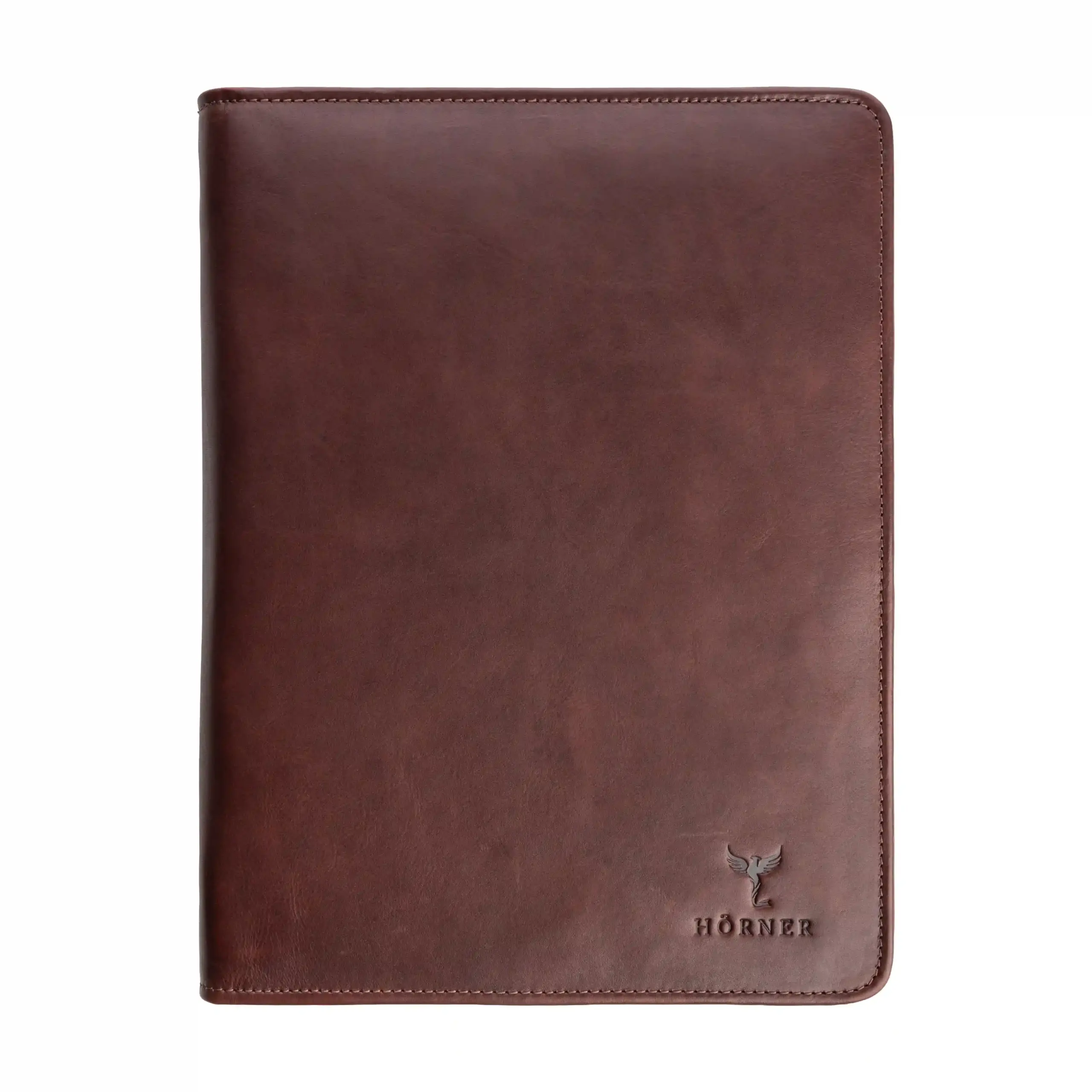
Across the range you will find the grades described above, chosen to suit the job. Our Paris padfolio (conference folder) is full-grain cowhide in cognac, with no surface correction, which is why it is the clearest example of the top grade in our catalog. The Fortis wallet is vegetable-tanned cowhide, the kind that earns a visible patina with use. Many of our wallets and card holders are soft full-grain nappa, often aniline or semi-aniline, for a refined hand in something you carry every day; if you are choosing one, our guide on how to choose a wallet goes deeper. Where a model uses suede or a particular finish, the product page says so.
Every piece ships from Germany with duties prepaid, from a named brand you can ask a direct question. If you want to see how the grades look across folders, wallets, bags and card holders, the full leather collection is the place to start, and each product names the leather it is made from.