Old money style and the watch it wears.
Three terms get used as though they mean the same thing, and they do not. This guide separates old money from quiet luxury and from minimalism, traces where the look actually comes from, and then spends most of its length on the object that carries it: the dress watch, its dial, its case height, its strap and its size.

Old money describes a wardrobe that looks inherited rather than assembled. Quiet luxury describes the garment, minimalism describes the reduction, and the three are not interchangeable. The watch that belongs to the look is the dress watch: thin enough to pass under a cuff, a calm dial, a leather strap, and a case sized to the wrist rather than to the room. None of that requires a high price.
What old money actually means.
Old money describes clothing associated with inherited rather than earned wealth: quality without visible branding, and a wardrobe that looks continuous rather than current. The signal being sent is not expense. It is familiarity with a set of codes.
That is why the look is so hard to buy in one afternoon, and why attempts to do so are usually detectable. A wardrobe that reads as old money is one where nothing is new all at once: a jacket with some age on it, shoes that have been resoled, a watch that clearly predates the outfit. The aesthetic is built on continuity, and continuity is the one component that cannot be ordered.
What can be adopted, and adopted honestly, is the underlying set of choices: restraint in branding, proportion over size, materials that improve rather than degrade, and objects bought once. That part is not a trend and is not new. It is classic menswear, which predates the phrase by about a hundred years.
The look is not expensive things. It is the absence of anything asking to be noticed, in a wardrobe that has clearly been there a while.Aus der Praxis · Andre Hörner
Old money, quiet luxury, minimalism.
These get used interchangeably online and they describe three different things. Separating them makes it much easier to work out which one you actually want.
| Term | What it is about | Where it shows | The giveaway |
|---|---|---|---|
| Old money | Continuity and social codes | A wardrobe that looks long-standing: prep, country, sailing, tennis references | Patterns and age. It is not plain, it is unannounced. |
| Quiet luxury | The garment itself | Fine materials, clean construction, no logos | It can be bought new, today, and look correct immediately. |
| Stealth wealth | Behavior more than clothing | Spending that does not announce itself | Used about people, not garments, in its original sense. |
| Minimalism | Reduction | Few pieces, few colors, no pattern | Old money is frequently patterned. Minimalism is not. |
The most useful distinction is the last one. People assemble a minimal wardrobe expecting it to read as old money and are puzzled when it reads as modern and corporate instead. A cable-knit sweater with a striped tie is busy, and it is squarely within the aesthetic. What the look avoids is announcement, not decoration.
Where quiet luxury tends to look polished and new, old money tends to look worn in. That difference is the whole reason the two terms exist separately, and it is what determines whether a purchase will do what you hoped.
Where the look actually comes from.
The vocabulary is not invented. Nearly every element traceable in old money dressing comes from a specific institutional context, which is precisely what gives it its coded quality.
Ivy and prep supply the oxford shirt, the navy blazer, the loafer and the repp stripe: the campus dress of a small number of American universities in the mid twentieth century, adopted outward from there.
Country and field clothing supply tweed, moleskin, waxed cotton and the muted greens and browns. These are working garments for shooting and riding, which is why they look correct with age and wrong when pristine.
Sailing and tennis supply the whites, the knitted vest, the striped knit and the rope-soled shoe. Both were amateur pursuits of people with time, which is the actual signal being sent.
Understanding the sources is more useful than a shopping list, because it tells you when something will look wrong. A garment borrowed from a context you are obviously not in reads as costume. The same garment worn plainly, in a color that has calmed down, does not.
The dress watch, defined.
There is a technical term underneath the trend phrase, and it is older and more precise: the dress watch. A thin watch, on a leather strap, with a legible and uncluttered dial, sized to pass under a shirt cuff.
That last clause is not one requirement among several. It is the requirement that produced all the others. A watch that has to slip under a cuff cannot be thick, which rules out most automatic movements with rotors and all diver cases. It cannot have a bracelet, which adds height and catches. It has no need of a rotating bezel, a tachymeter or a chronograph pusher, because none of those are useful at dinner. Strip out everything the cuff forbids and the classic dress watch is what remains.
| Category | Case | Dial | Strap | Reads as |
|---|---|---|---|---|
| Dress watch | Thin, plain bezel | Two or three hands, minimal text | Leather | Formal, quiet |
| Field watch | Medium, robust | High-contrast numerals | Leather or nylon | Practical, casual |
| Dive watch | Thick, rotating bezel | Large lume markers | Steel or rubber | Sport, deliberate |
| Chronograph | Medium to thick, pushers | Subdials, scales | Either | Technical |
| Skeleton | Usually thick | Movement visible through the dial | Either | Mechanical display |
The last row is worth being blunt about, including where it applies to us. A skeletonized dial is an invitation to look at the movement, which is a fine thing to want and the exact opposite of what this look asks for. Our own Pulsar is a skeleton watch, so it is the wrong watch for this brief despite being the more mechanically interesting of the two we make.
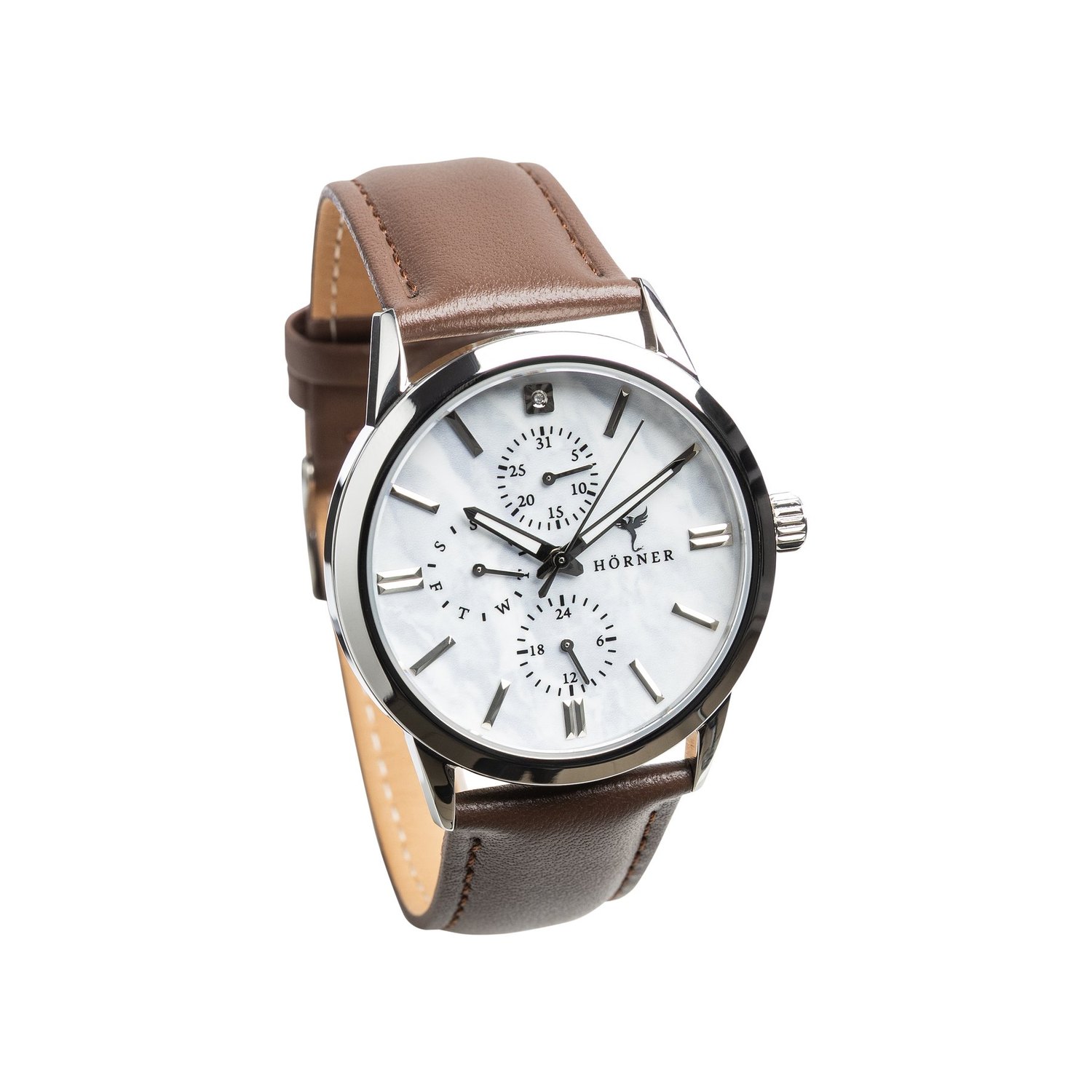
A word about our own, because the definition above is strict and almost no watch anyone actually wears meets all of it. The Nova carries a multi-eye dial reading date, weekday and a 24-hour scale, so it is not the two-hand purist reading of the category. On the wrist it does the part that decides the look: a 40 mm steel case, a sapphire crystal, a leather strap, and a dial laid out quietly enough that you read the time and nothing on it is competing for attention. Purism is a useful yardstick here, not a shopping rule.
Light ground, quiet order.
The dial is where the category is won or lost, and the test is simple: can you read the time in one glance, and is there anything on it that is not doing a job?
Ground. Traditionally light: silver, white, cream, champagne. Dark dials are entirely acceptable and read as slightly more modern. What matters more than the color is that it is even and not textured to the point of distraction.
Markers. Applied indices or plain numerals, in one style. Mixed systems, roman at the quarters and batons elsewhere, are a period look rather than a neutral one.
Text. As little as possible. A brand name, and ideally nothing else. Dials that list the movement, the water resistance, the material and a certification are doing marketing on the wearer's wrist.
Complications. A date window is accepted and useful. Anything beyond that belongs to another category. The absence is the point: a dress watch is the one instrument in a man's possession that does exactly one thing.
Photograph the dial and look at the picture at thumbnail size. If you can still tell the time instantly, the dial is doing its job. If the markers dissolve into decoration, it is a design object rather than a dress watch, whatever the price.
Case height, and where the rule comes from.
The rule is that the watch passes under a shirt cuff without snagging or forcing the cuff open. In numbers, that puts the traditional target at roughly 10 mm or less, and the watches most admired in the category sit considerably below it.
Where this gets practical is the movement. An automatic carries a rotor, and a rotor takes height. That is why so many thin dress watches are hand-wound or quartz, and it is the single most useful thing to know when shopping: if a watch is thin, its movement is telling you something about itself. A quartz movement in a dress watch is not a compromise so much as a solution to the geometry problem the category is built around.
The corollary is worth saying plainly. A 13 mm sports case does not become a dress watch by having a leather strap fitted. Strap changes are the cheapest and most common attempt at the look, and they do not address the dimension the rule is actually about.
Leather over steel.
Leather, in the traditional reading, and for reasons that are mechanical before they are aesthetic. A bracelet adds height at the lugs, adds weight, adds a second shining surface, and catches on a cuff every time the arm moves. Every one of those works against the brief.
On color, the same logic as any other leather on you applies, which is covered at length in brown and black together: the strap is the third leather surface, after the belt and the shoes, and it is the cheapest of the three to change. Black with black shoes, brown with brown, and a strap that agrees with one of the other two if they disagree with each other.
On width, a tapering strap, wider at the lugs than at the buckle, is the traditional shape and sits better under a cuff than a parallel one. Our own Nova uses a cowhide strap that tapers from 22 to 20 mm, which is the conventional proportion for a 40 mm case.
One practical note that gets left out of style writing: a leather strap on a watch worn daily will need replacing long before the watch does. That is a consumable, not a defect, and having a second strap means one can dry out while the other is worn. It also doubles what a single watch can do.
What fits the wrist.
The classic range runs from about 34 to 40 mm. Below that reads vintage, above it starts to fight the category, and the correct figure inside the range is decided by your wrist rather than by the number that sounded right online.
The test is the flat of the wrist. Lay the watch on and look from directly above: the case should sit within the flat area, not overhang toward the bony sides. A case that overhangs will also rock when the arm is at rest, which is visible and slightly cheap-looking regardless of the watch.
Two secondary numbers matter more than most buyers expect. Lug to lug is the length across the case including the horns, and it determines whether the watch fits your wrist far more directly than the diameter does. Lug width determines which straps fit, and a common width, 20 or 22 mm, means straps will be easy to find in ten years.
For reference on where a real object lands in this range: the Nova is a 40 mm steel case, at the upper end of the classic band, with a sapphire crystal that has anti-reflective coating on both sides. That is a modern size rather than a vintage one, which suits a watch meant to be worn with a suit and also with a sweater.
What to check before you buy.
Quality marks in general are covered in how to spot a good watch. What follows is specific to this category, and it is the short list worth carrying into a purchase.
| Check | What you want | Why it matters here |
|---|---|---|
| Case height | Around 10 mm or under | The rule the whole category is built on. Not negotiable by strap choice. |
| Crystal | Sapphire if possible | A scratched crystal on an otherwise quiet watch is the thing people notice. |
| Dial text | As little as possible | Text is the most common failure in watches otherwise built for this look. |
| Lug to lug | Fits the flat of your wrist | Determines fit more directly than diameter, and is rarely listed. |
| Lug width | A common size, 20 or 22 mm | Straps are consumables. An unusual width makes that expensive later. |
| Water resistance | At least 3 ATM, 5 is comfortable | Thin cases are usually modest here. Know the number before it rains. |
| Movement | Either, chosen deliberately | Quartz buys you thinness and accuracy; automatic buys mechanical interest. |
The last thing to check is the honest one. If you are buying because the phrase is everywhere this year, buy the underlying object rather than the label: a well-proportioned watch with a calm dial will still be right when the term has been replaced by the next one. That has happened to every name this aesthetic has been given, and the watches did not change.