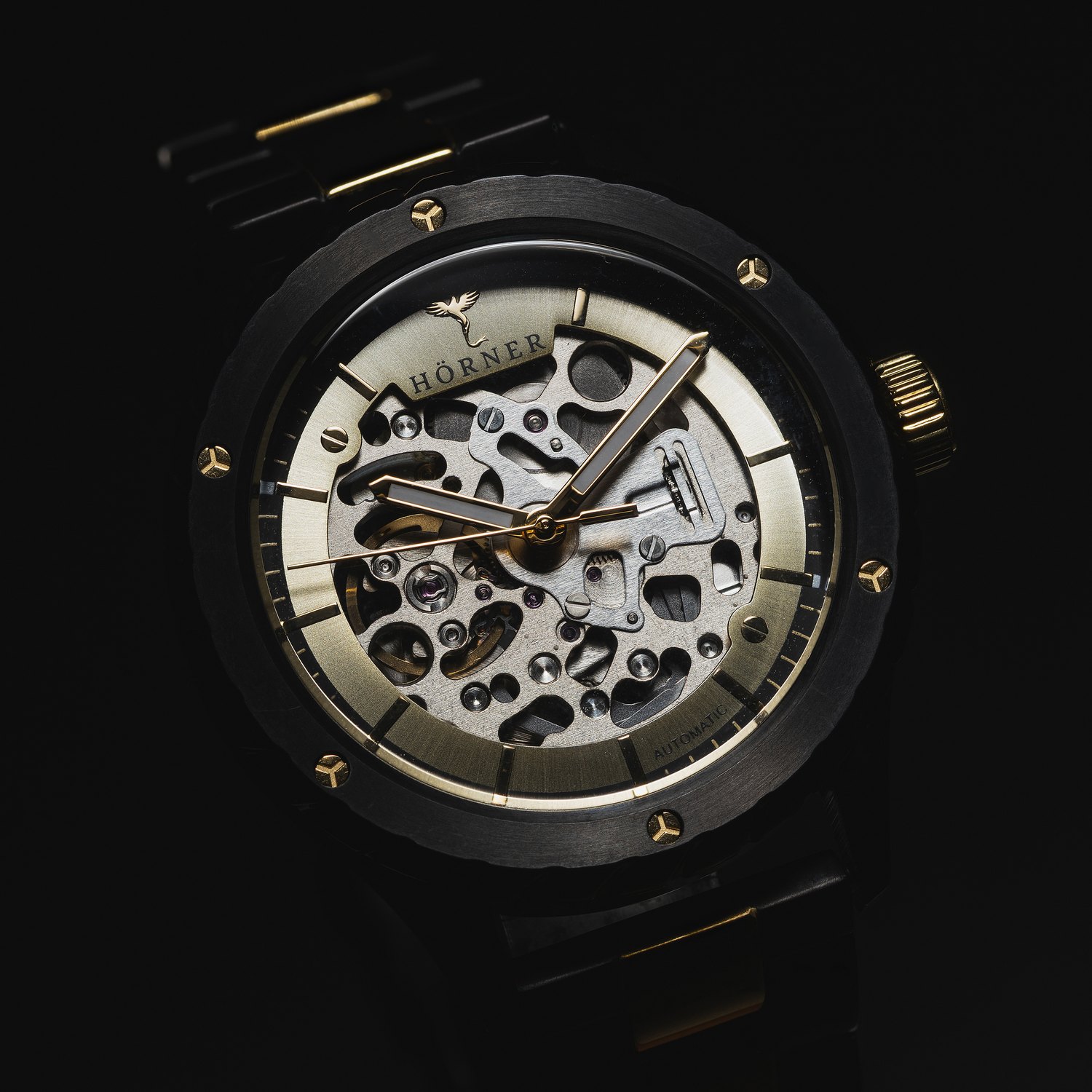
How to wind an automatic watch, the right way.
An automatic watch is meant to run from your wrist, but sooner or later you'll need to wind one by hand, after a weekend in a drawer, before wearing one for the first time, or just to bring it back to life. Here is how to do it, why you cannot overwind it, and the one setting habit worth knowing if your watch shows a date.

Wear an automatic watch and its rotor winds it for you. If it has stopped, hold it in your hand and turn the crown clockwise about 20 to 30 times, then set the time. You cannot overwind it: the mainspring simply slips once it's full. The only real caution is the date window on watches that have one, never force it in the few hours before or after midnight. Our own Pulsar skips the date entirely, so that caution never applies to it.
Wear it, or wind it.
An automatic watch has two ways to gain energy: the motion of your wrist, and the crown. In daily use, wearing it is enough. The rotor inside turns with every movement of your arm and keeps the mainspring topped up without you ever touching the crown.
Hand-winding comes in when the watch has actually stopped, most often after sitting unworn longer than its reserve lasts. A stationary watch doesn't need any special care, and you cannot damage it by winding it. The rest of this guide covers exactly how, plus the one habit worth knowing if your watch has a date function.
How an automatic actually keeps going.
Inside the case sits a rotor, a half-moon weight that swings freely as your arm moves. Each swing winds the mainspring a little further, and that stored tension is what drives the gears, the balance wheel, and ultimately the hands.
How much energy the spring can hold is called the power reserve, and it varies by movement. Most automatic calibers, including the NH70 that runs our own Pulsar, sit somewhere in the range of 36 to 48 hours fully wound. Wear the watch daily and you'll never notice the number: the rotor keeps refilling the reserve as fast as it drains. Leave it in a drawer over a long weekend, though, and it will run out before you pick it back up, which is simply the mechanism working exactly as designed.
Hand-winding, step by step.
Winding an automatic by hand is a two-minute job, and there's no way to rush it into damage:
| Step | What to do |
|---|---|
| 1. Remove it | Take the watch off your wrist so the crown is easy to reach and turn |
| 2. Wind | With the crown in its normal, pushed-in position, turn it clockwise about 20 to 30 times, until the second hand sweeps smoothly |
| 3. Set the time | Pull the crown to its time-setting position and adjust the hands (date first, if your watch has one, see below) |
| 4. Wear it | Put it back on. From here, your wrist keeps the reserve topped up |
Some automatic movements only wind through the rotor and don't hand-wind at all. You'll feel the difference immediately: turn the crown gently in its pushed-in position, and a movement built for hand-winding gives steady resistance and a faint ratcheting feel, while a rotor-only movement just spins free. If in doubt, a gentle shake gets a rotor-only watch started before you set the time.
Can you overwind it? No, and here is why.
Overwinding is the most common worry people bring to an automatic, and it's a holdover from a different kind of watch. Old-fashioned hand-wind-only movements can hit a hard stop, and forcing the crown past it really can snap the mainspring.
An automatic's mainspring ends in a slipping bridle. Once it's full, the bridle simply slips, and turning the crown further does nothing at all.Aus der Praxis · Andre Hörner
An automatic works differently on purpose. Its mainspring connects to the barrel through a slipping bridle, a deliberately loose coupling that lets the spring spin freely in place once it has taken on all the tension it can hold. Keep turning the crown past that point and nothing happens, good or bad, the mechanism just stops taking on energy. That's what makes automatics forgiving enough to wind from the random motion of a wrist all day without any risk of over-tensioning.
It stopped. Now what?
A stopped automatic is not a malfunction, it's the power reserve running out after too long unworn. Wind it, set it, wear it, in that order. Winding first matters: a watch with too little reserve left can stall again partway through setting the time, and you'd have to start over.
Some people restart a stopped automatic with a firm shake instead of the crown. It can work, since it gives the rotor a burst of motion, but it's rougher on the movement and less reliable than simply winding it by hand. The crown method takes about the same amount of time and treats the watch better.
The one thing to avoid, if it has a date.
This is the single mistake that can genuinely cost you a repair bill, and it only applies to automatics with a date window. In the hours around midnight, usually somewhere between about 9pm and 3am, the movement's gears are already mid-motion, preparing to advance the date. Force the quick-set date function during that window and you're pushing directly against those engaged teeth.
The safe habit: move the hands to about 6am first, then set the date, then set the correct time.Aus der Praxis · Andre Hörner
The fix is simple and worth memorizing if you own a dated automatic: pull the crown to the time-setting position and move the hands forward to roughly 6 o'clock, well clear of the danger window, before you touch the date. Set the date there, then continue moving the hands forward to the correct current time. It's a small extra step that protects a genuinely delicate part of the movement.
Plenty of automatics, ours included, skip the date window entirely for a cleaner face and one less thing to think about. Our Pulsar's skeletonized NH70 movement shows no date at all, so the caution above simply never comes up if that's the watch on your wrist.
Do you need a watch winder?
A watch winder is a small motorized box that turns a stored watch just enough to keep its rotor moving, so it never fully runs down. It sounds essential, and for most people it isn't.
- One watch, worn most days: No winder needed. It's back on your wrist well within its reserve, and resetting it after an occasional stop takes under two minutes.
- Several automatics in rotation: A winder earns its keep here, so each piece is ready to wear without a reset every time you switch.
- A perpetual calendar or similarly complex watch: Worth considering, since resetting a full calendar by hand can take real time and patience.
We don't sell watch winders, this guide is deliberately neutral on the question. For a single, regularly worn automatic, the honest answer is that you're paying for convenience, not necessity.
When it is time for a service.
A mechanical movement is fine engineering with real lubrication inside, and that oil ages. As a rough guide, plan on a service every three to five years, depending on how often the watch is worn.
Two signs tell you sooner rather than later: the watch keeps noticeably worse time than it used to, or its power reserve seems shorter than it once was, stopping faster after the same time off the wrist. One more thing worth ruling out first: if a watch suddenly runs fast, it's often simply been magnetized by a speaker, tablet, or magnetic clasp nearby, which a watchmaker fixes in seconds without a full service. If the timing issue persists after that, a service is the next step.
None of this is specific to any one brand or movement. The care that keeps a leather strap looking good is its own subject, covered in our guide to changing a watch strap, and if you're still deciding between mechanical and quartz altogether, our honest automatic vs quartz comparison lays out both sides with no winner declared.