Ebony wood, and why it makes the finest pens.
Ebony has been a symbol of luxury since ancient Egypt: a wood so dense it sinks in water, so hard it outlasts almost everything made from it, and so rare it costs ten times what oak does. That combination is exactly what makes it one of the great materials for a pen. Here is what ebony is, why it is so prized, and what it brings to the pen in your hand.
Ebony is the dark, dense heartwood of Diospyros trees from Africa and Southeast Asia, one of the hardest and heaviest woods in the world. It is deep black, fine-grained, takes a lustrous polish and ages beautifully. It is rare and protected, so it costs around ten times the price of oak, and responsible makers use only non-endangered stocks. In a pen, its hardness, weight and warmth make for a barrel that feels substantial and lasts for decades.
What ebony is, and why it is prized.
Ebony has carried an aura of luxury for a very long time. It was prized in ancient Egypt, traded as a precious good, and named in the oldest texts as a mark of wealth. Few materials have that kind of pedigree.
The reason is in the wood itself. Ebony is extraordinarily hard, extraordinarily dense, deep black, and genuinely rare. Each of those qualities is desirable on its own. Together they make a material that has been the first choice for fine furniture, musical instruments and, today, the finest writing instruments.
For a pen, that translates into something you can feel the moment you pick it up: real weight, a warm, solid barrel, and a finish that still looks the part years from now. The rest of this guide explains where each of those qualities comes from.
What exactly is ebony wood?
Ebony is not one tree but a family. It is the dense heartwood of trees in the genus Diospyros, which grow across tropical Africa and Southeast Asia.
The classic ebony is a deep, near-uniform black, most famously the ebony from Cameroon. Other varieties are not solid black at all: Makassar ebony from Indonesia, for example, is dramatically striped in browns and black. What they share is the prized part of the tree, the dark heartwood at the very center.
That heartwood is only a fraction of the trunk. In some trees barely a third of the timber is the usable, valuable wood, which is one of the reasons ebony has always been precious and never plentiful.
How hard and dense is it?
Ebony sits at the far end of almost every scale used to measure wood. The figures are worth knowing, because they explain why an ebony pen behaves the way it does.
Density. Ebony runs roughly 1,000 to 1,200 kilograms per cubic meter, about twice the density of oak. That is at or above the density of water, which is why a solid piece of true ebony usually sinks rather than floats, an old, simple test for the real thing.
Hardness. On the Janka scale, the standard measure of how a wood resists wear and denting, true ebony exceeds 3,000 lbf. That is around three times harder than walnut and well beyond the woods used for most furniture. A thin pen barrel made from it shrugs off the knocks of daily carry.
A wood so dense it sinks and so hard it outlasts what is built from it. That is the short explanation for everything ebony is used for.On ebony
Black, fine-grained and lustrous.
Beyond the numbers, ebony simply looks and feels like a precious material, which is half the reason it ends up in objects people keep.
The grain is very fine and the pores are tiny, so the surface takes an exceptionally smooth, lustrous polish. Classic ebony shows almost no visible growth rings, giving that deep, even black. And because it is a natural wood, the subtle variations in grain mean no two pieces are identical, so every ebony pen is, in a small way, one of a kind.
It also ages well rather than badly. Where cheaper materials scuff and dull, ebony deepens and keeps its luster, which is why ebony instruments and furniture from generations ago still look the part today.
Why it is rare, costly and protected.
Ebony has never been a wood you could buy by the truckload, and today there is an added layer of responsibility around it that any honest maker has to respect.
Start with price. True ebony commonly costs more than ten times the price of oak, often north of $20,000 per cubic meter. The reasons are simple: the trees are slow-growing, only a fraction of each yields usable heartwood, and the wood is hard and demanding to work.
Then there is protection. Of roughly 100 ebony species, around a third are classified as severely endangered or threatened. Those varieties are listed and specially protected, no longer part of the regular trade, and require proof of origin to move at all. The honest response is straightforward: do not touch the endangered species, and work only from non-endangered stocks.
That is exactly the line we take. At Hörner, our ebony is drawn from stocks of non-endangered species, so refinement and sustainability go hand in hand. A precious, protected material is also a good reason to make a pen worth keeping for life rather than a thing to be replaced.
The most sustainable thing you can do with a rare, slow-growing wood is to use a little of it, responsibly, in something built to last decades. A single ebony pen, sourced from non-endangered stock and kept for a lifetime, honors the material far better than cheap wood in a throwaway object ever could.
Why ebony makes a great pen.
Everything above comes together at the moment you pick up an ebony pen. This is where the material earns its reputation.
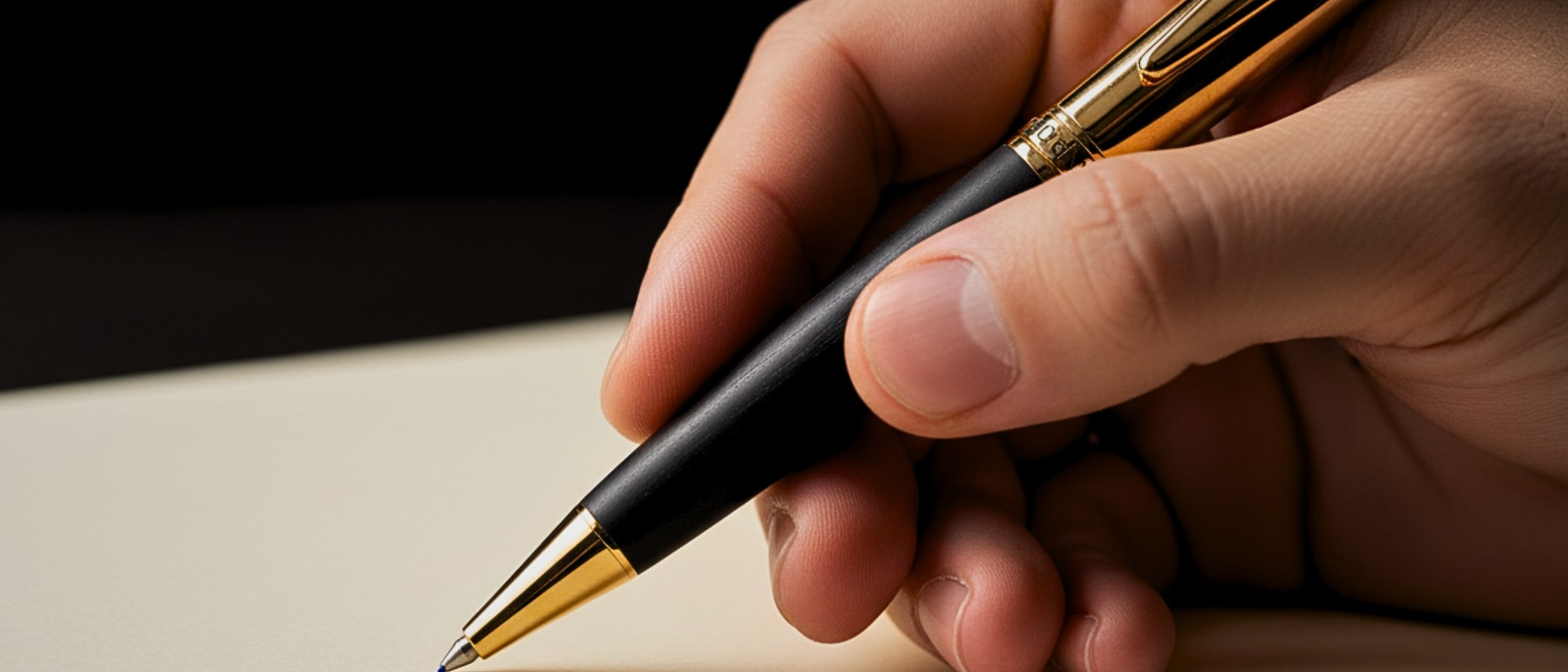
The density gives a barrel real weight and balance, so the pen feels solid and intentional rather than hollow and light. The hardness means a thin wooden barrel can take years of daily handling without denting or wearing through. Wood warms to the hand far quicker than metal, so it is comfortable to hold for a long letter. And the deep black grain, set off by a gold or chrome nib, simply looks like something made to last.
It is also low-maintenance in use. The same density that makes ebony hard also helps it resist moisture and everyday marks, so the pen stays looking good with almost no effort. For what a fine pen should be, material, balance and longevity, ebony is hard to beat. See also our guide on what makes a good fountain pen.
Caring for an ebony pen.
An ebony pen asks very little of you, which is part of the appeal. A few simple habits keep it looking its best for decades.
Wipe the barrel now and then with a soft cloth, dry or barely damp. Keep the pen away from prolonged direct sun, extreme heat and very dry air, which are hard on any natural wood over time. An occasional, sparing touch of a wood-safe care oil keeps the finish deep and rich, though ebony's natural density means it rarely needs much.
If it is a fountain pen, the nib and feed are cleaned the usual way, separately from the wood. Our guide on how to clean a fountain pen covers that routine. Treated this simply, an ebony pen is the kind of object you hand on rather than replace.
Hörner's ebony pens.
Ebony runs right through our collection, because it is the material that best expresses what we want a Hörner pen to be: substantial, lasting and a pleasure to hold.
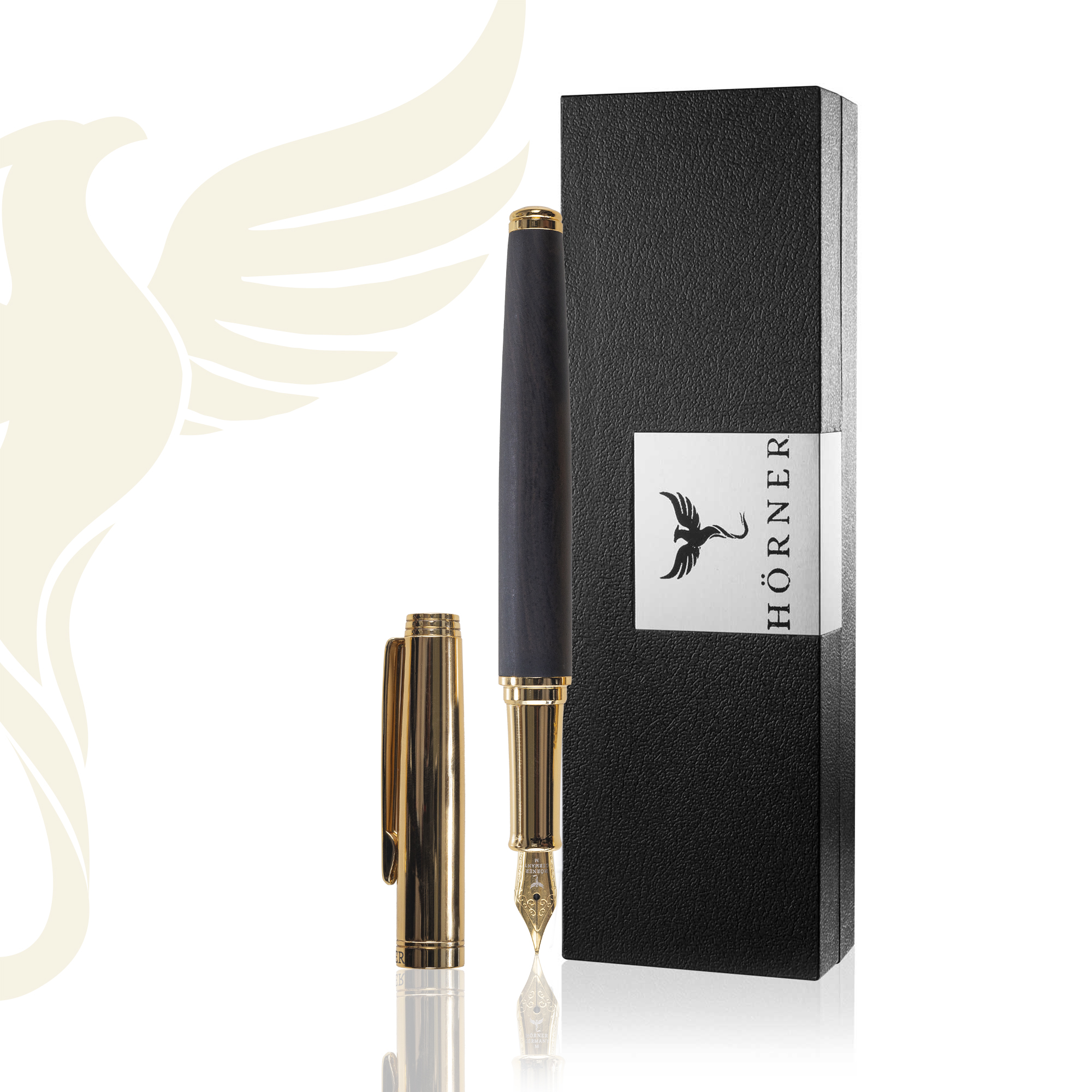
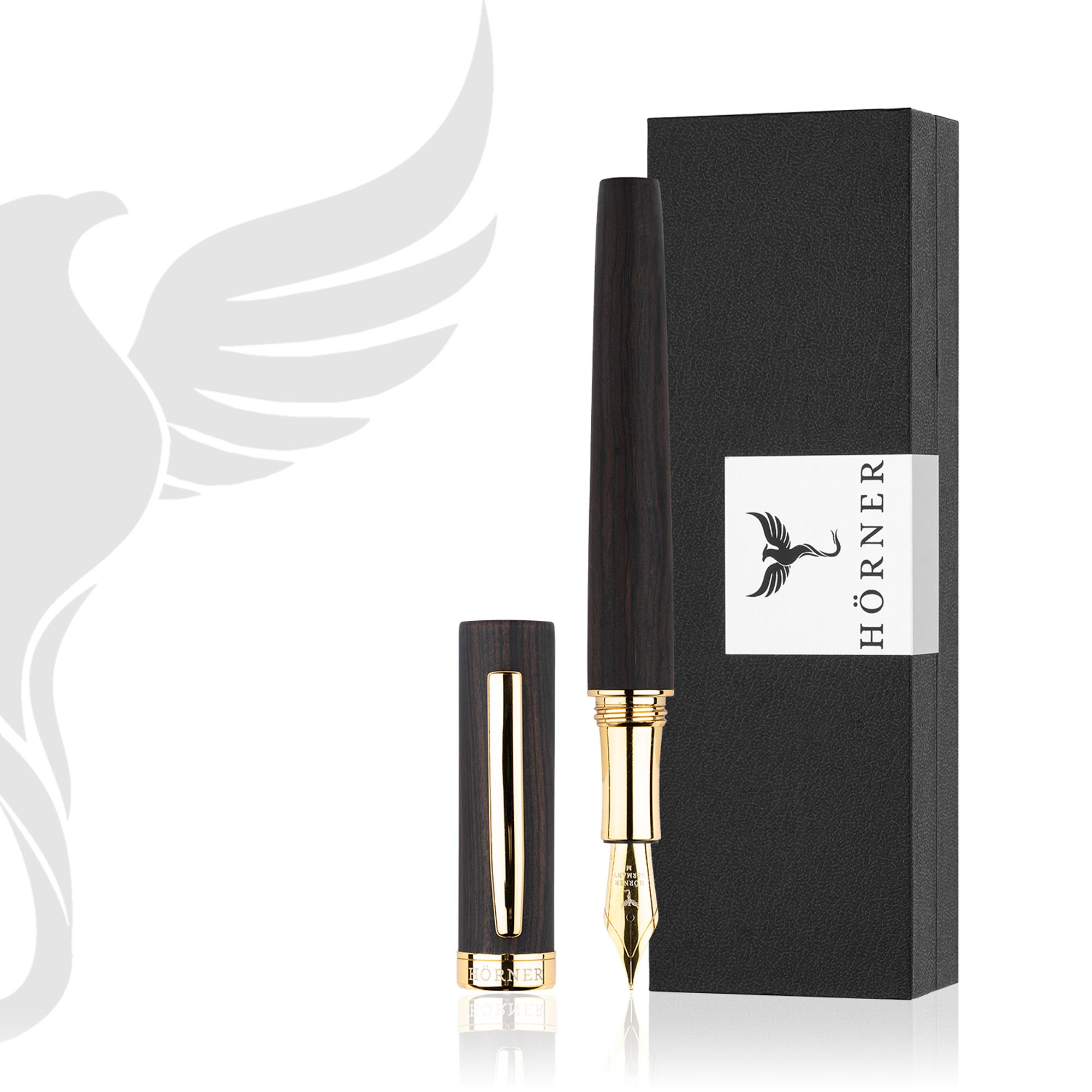
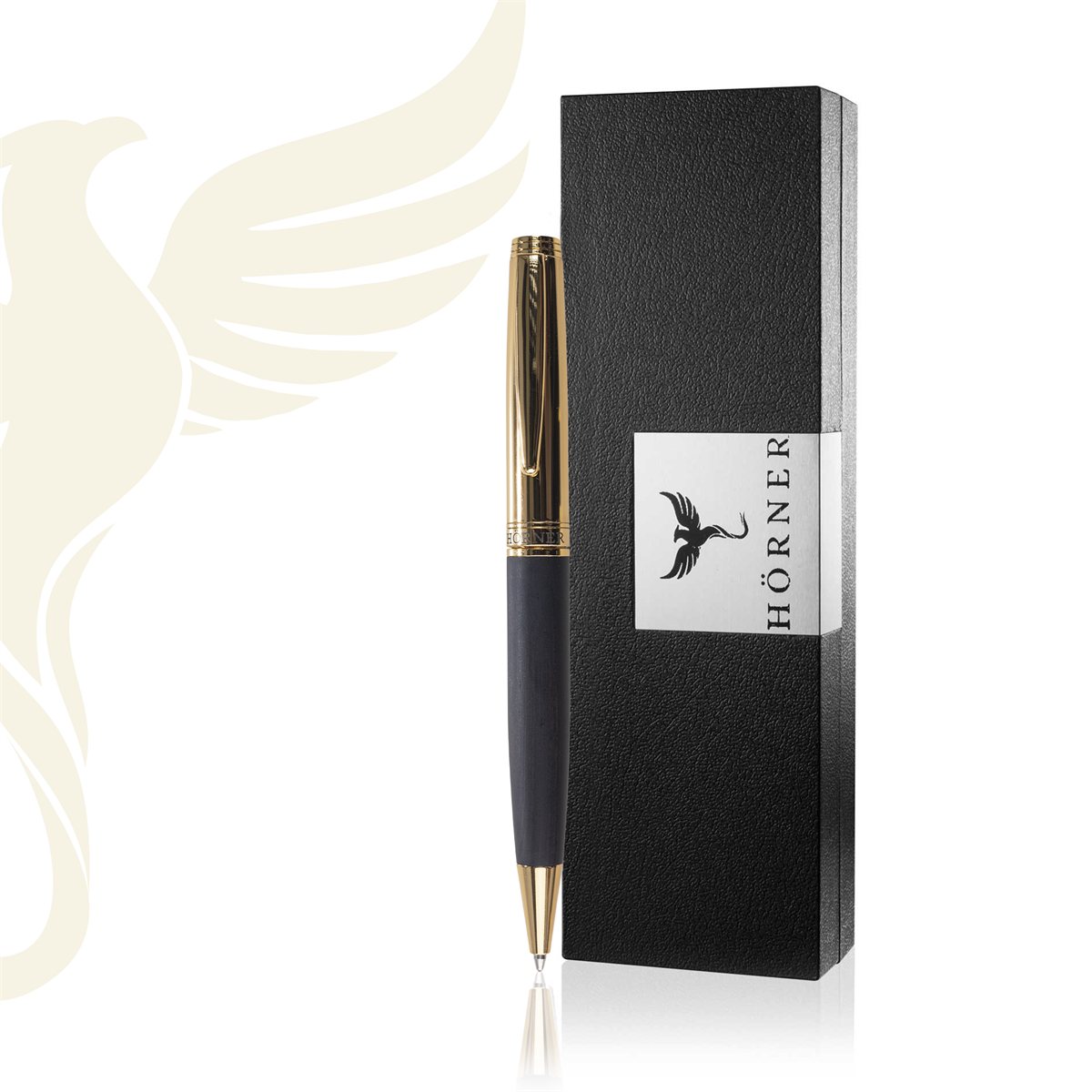
The Legno line is the accessible way in, real ebony over a brass core in a fountain pen, rollerball or ballpoint, each with a German JoWo nib or a quality refill. The Scriptum is the step up, solid near-black ebony with gilded accents and a gold-finished nib, a pen that reads as an heirloom. Across the range, the wood is drawn from non-endangered stocks, and every pen can be engraved with a name or date, which is what turns a fine object into a personal one.
Whichever you choose, it is a traceable pen from a named retailer with duties prepaid, made from one of the world's great woods, and built to be kept.