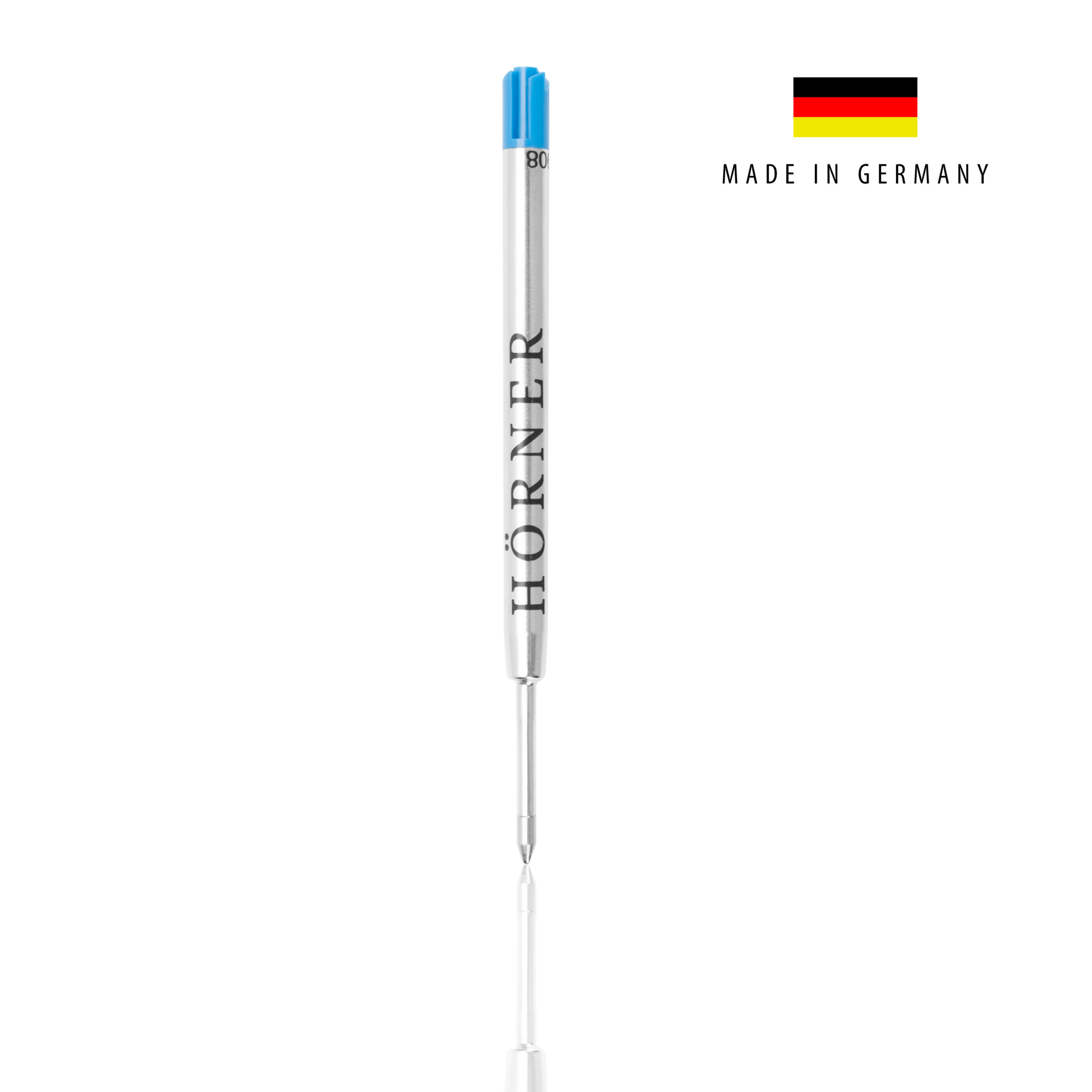
Ballpoint pen refills, and how to find the right one.
A good pen should outlast many refills, so the only real question is which one fits. The answer is a format, not a brand: most full-size ballpoints take a G2, slim pens take a D1, and rollerballs and fountain pens are different systems again. This guide makes the choice quick and certain.
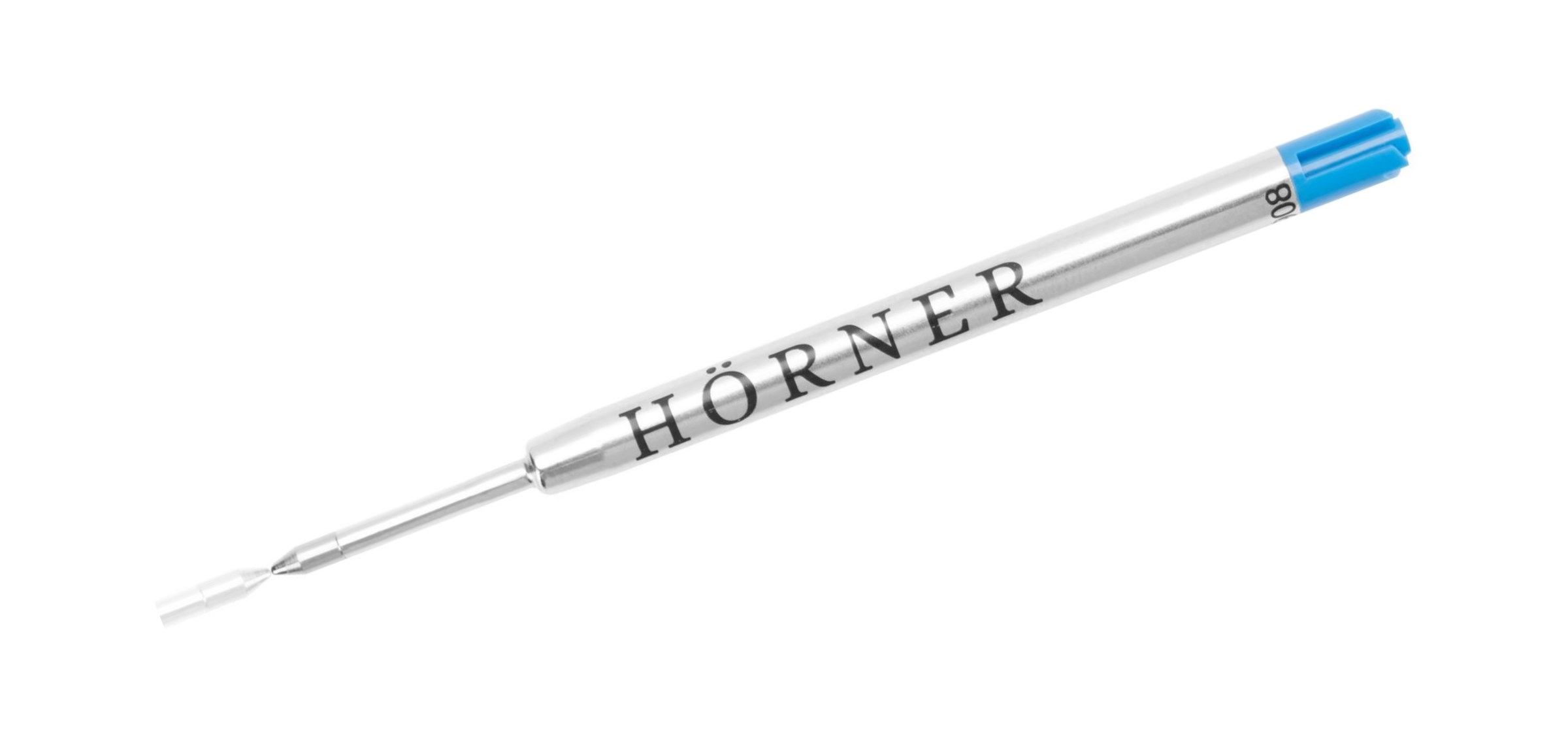
Ballpoint refills come in formats, not brands. The large G2 (Parker-style) refill fits most full-size metal ballpoints; the slim D1 fits compact and twist pens. They are not interchangeable, so identify your format first, then pick the tip and color. A soft refill is the same fit with a smoother ink. Rollerball refills and fountain pen cartridges or converters are separate systems. When unsure, pull the old refill and measure it.
Which refill do I need? Match the format, not the brand.
The single most useful thing to know about pen refills is that they come in standard formats, not proprietary brand parts. A refill that fits one pen built for that format fits most others built for it, whatever the name on the barrel.
For ballpoints, that comes down to two formats almost all of the time. The G2, often called Parker-style, is the large refill in most full-size metal pens. The D1 is the slim refill in compact, twist-action and multi-pens. Get the format right and the refill simply works. Get it wrong and it will not seat at all.
Rollerballs and fountain pens are separate systems, and we cover them below. But if you are holding a normal full-size ballpoint, the odds are very high you need a G2, and we will show you how to be sure in a minute.
Full-size metal ballpoint? You almost certainly need a G2 (Parker-style) refill. Slim or twist pen? You need a D1. Not sure? Pull the old refill out and measure it: near 98 mm (about 3.9 in) is a G2, near 67 mm (2.6 in) is a D1.
What kind of pen are you refilling?
Pick your pen type. The finder names the format you need and the matching Hörner refill.
The ballpoint formats: G2, D1, A2 and C1.
Ballpoint refills are sold by format, which is why a G2 from one maker drops into another maker's G2 pen. G2 and D1 cover almost every pen you will meet, while A2 and C1 appear less often. Here is how they compare, with the writing range from our own figures.
| Format | Length | Diameter | Writing range | Fits |
|---|---|---|---|---|
| G2 (Parker-style) | 98 mm / 3.9 in | 6 mm | about 11 km, roughly 7 miles | most full-size metal ballpoints |
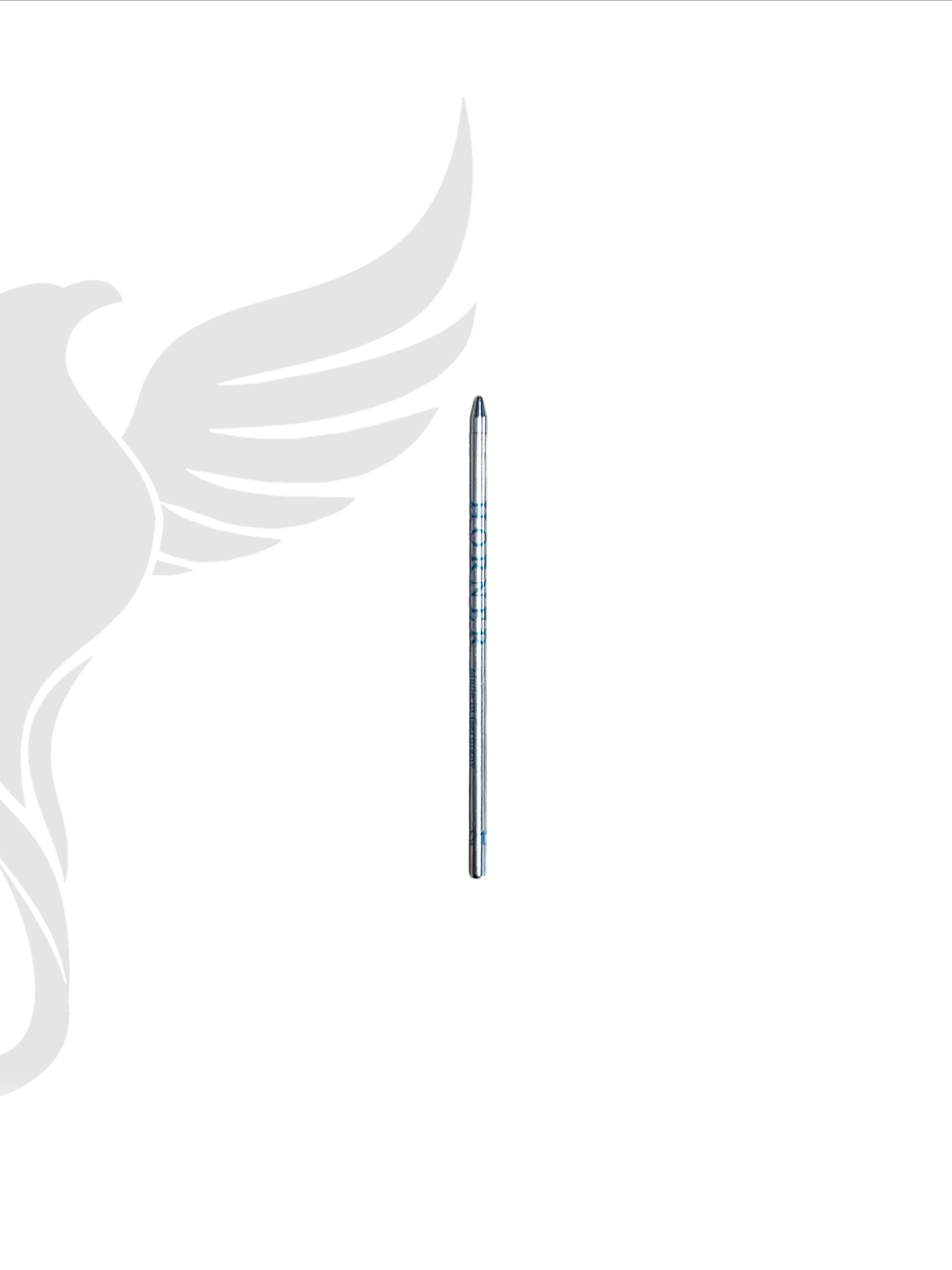
| D1 | 67 mm / 2.6 in | 2.35 mm | about 1.4 km, roughly 0.9 miles | slim, compact, twist and multi-pens |
| A2 | 106 mm / 4.2 in | 3.2 mm | about 4 km, roughly 2.5 miles | larger promotional and standard pens |
| C1 | 117 mm / 4.6 in | 3.05 mm | varies by refill | many Cross pens, not compatible with G2/D1/A2 |
The G2 is the workhorse: the most ink, the longest writing range, an easy fit in most full-size pens, and the format our own metal ballpoints use, so you are never tied to a special size. The D1 exists for one good reason, which is that a slim pen has no room for a fat refill. If your pen is noticeably thin, it almost certainly takes a D1, and a G2 simply will not go in. The A2 is an older, larger promotional format you see less often, and the C1 is Cross's own longer refill, so a Cross pen usually will not take a G2.
What about my Parker, Cross or Waterman? Because the Parker-style G2 is a shared format, a G2 refill is interchangeable across the many pens built for it, whatever the brand on the barrel, and dozens of makers produce a G2-compatible refill. A few brands are the exception and fit their own proprietary refill rather than a G2, Cross, Lamy and Waterman among them, so confirm your pen takes a Parker-style G2 before you swap. When it does, our G2 drops straight in.
How long does a refill last? More than people expect. As a guide figure, a G2 writes on the order of 11 km of line, around seven miles, before it runs dry, while the slim D1 holds less and runs to about 1.4 km, roughly 0.9 miles. Mileage also shifts with the point size: a fine point can stretch a G2 toward 14 km, while a broad one, laying down more ink, runs closer to 7 km, with the 11 km figure sitting at the medium point most people use. In normal daily use a quality G2 lasts many months, far longer than the cheap pens it replaces.
Refills are one of the few pen parts that are genuinely standardized. Learn your format once, and you never have to guess at the brand again.From experience · Hörner
G2 is not always G2: the Pilot trap.
Here is the mix-up that trips up more shoppers than any other, and it is worth thirty seconds. The letters G2 get used for two completely different things.
Parker-style G2 is a refill format, the 98 mm large-capacity refill this guide is about. Pilot's G2 is a finished gel pen, one of the best-known pens in the country, and its refill is a different size entirely. A Parker-style G2 refill will not fit a Pilot G2 gel pen, and a Pilot G2 refill will not fit a Parker-style pen. Same two letters, unrelated parts. When you search, look for "Parker-style" or the 98 mm size, not the letters alone.
There is a smaller catch even within the real format. G2 is a nominal size, and makers hold their tolerances differently, so two refills that are both honestly labeled G2 can differ slightly in diameter, by up to about three quarters of a millimeter in one maker-to-maker comparison. Most of the time it makes no difference. Occasionally a new refill feels a shade loose or tight even though it is the right format, and that is tolerance, not a defect.
Buying for a full-size metal pen with a twist or click mechanism? That is the Parker-style G2 in this guide. Buying a refill for a Pilot G2 gel pen? That is a different part, sold as a Pilot G2 gel refill. If one refill feels slightly off in a G2 pen, keep the old refill as your size reference.
Soft or standard: how the refill writes.
Within the G2 format there is a second choice that has nothing to do with fit and everything to do with feel: a standard refill or a soft one. The rule behind it is worth knowing, because it is a genuine trade-off. The softer a refill writes, the more ink it lays down, so the shorter its writing range.
| Refill | Feel | Writing range |
|---|---|---|
| Standard | crisp, controlled | about 11 km, roughly 7 miles |
| Soft (G2 Softline) | smoother, low pressure | about 5 km, roughly 3 miles |
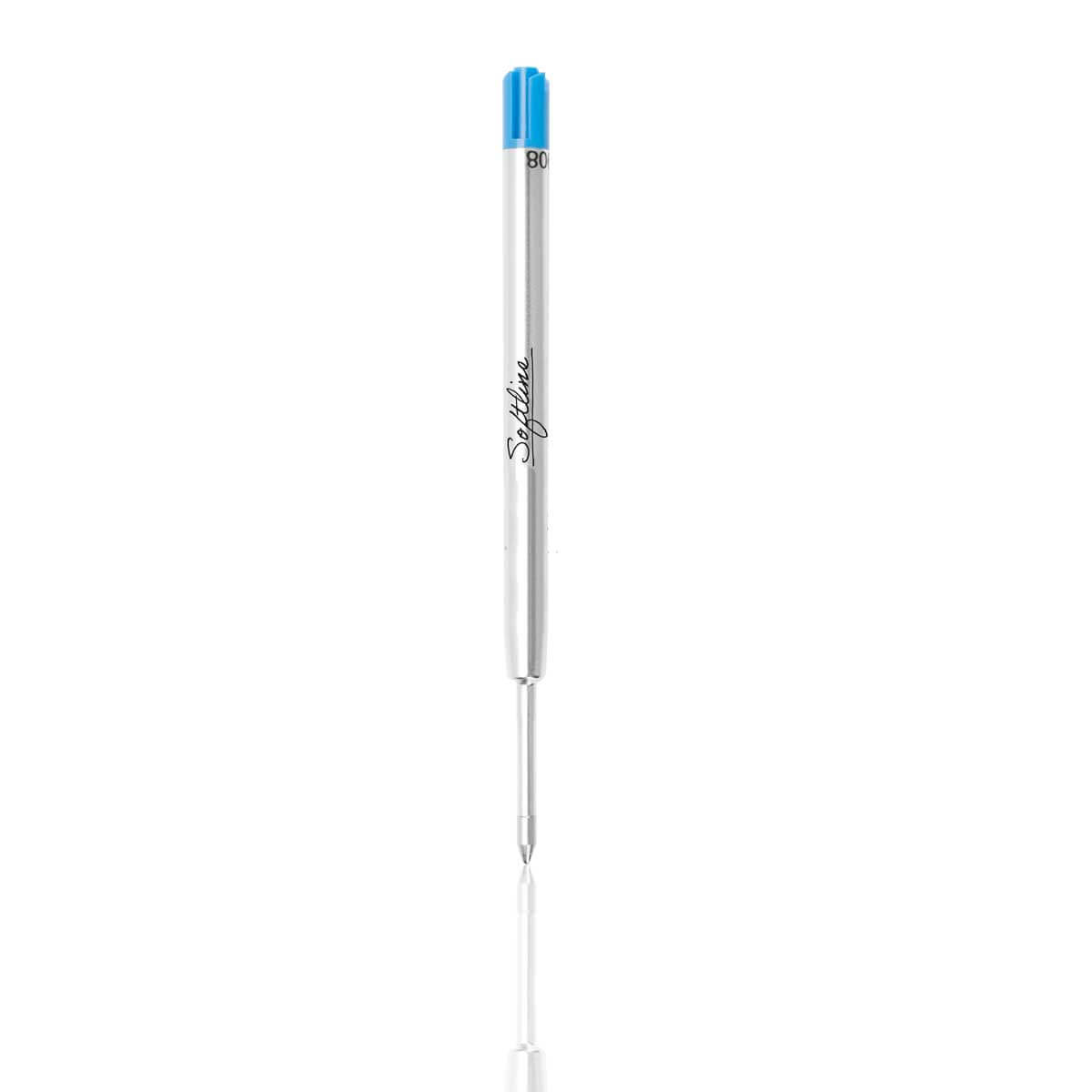
A standard ballpoint refill uses a firmer, oil-based paste that lays down a crisp, controlled line and lasts the longest. A soft refill, which we sell as the G2 Softline, uses a more lubricated ink that glides with less pressure, the version heavy writers reach for on long sessions; it writes beautifully but burns through ink faster, which is why it covers about five kilometers rather than eleven. Both are the same G2 fit, so swapping between them changes nothing about the pen.
One honest caveat: with soft refills, quality matters more than anywhere. A cheap soft refill often writes worse than a good standard one, because the smoothness lives in the ink, and poor ink skips and drags. It is worth remembering that the refill, not the pen, is what actually writes, so even a fine pen disappoints with a poor refill. The good news is that trying the other feel costs only the price of a refill.
Tip width and ink color.
Once the format is settled, the rest is quick. Two small choices remain: the tip width and the ink color.
Tip width, or point size. A medium point is the everyday all-rounder, balanced for most hands and most paper, and it is what our refills use. A finer point suits small writing and detailed forms; a broader one lays a bolder line. For general writing, medium is the safe default and rarely the wrong call.
| Point | Ball | Line on paper | Best for |
|---|---|---|---|
| F (fine) | 0.7 mm | about 0.5 mm | precise notes, small writing |
| M (medium) | 1.0 mm | about 0.8 mm | everyday writing, the default we ship |
| B (broad) | 1.2 mm | about 1.0 mm | signatures, bold writing |
Ink color. Our standard G2 refills come in blue, black, red and green, the Softline in blue and black, and the D1 in blue and black. Most people keep a blue or black for daily writing and a spare in the drawer. Buying a multi-pack means you are never caught out by a pen that runs dry mid-sentence.
Keep one spare refill per pen you use often. A refill is inexpensive, it stores for years, and it turns "my pen died" into a ten-second fix instead of a trip to the store. A good pen is built to outlast dozens of refills, so the refill is the only consumable you ever really buy.
Document-proof: what actually lasts.
For contracts, checks and anything you sign, one property matters more than color or feel: whether the ink is document-proof, meaning it resists water, light, solvents and erasing over time. This is set by a standard, not by the color of the ink.
The international standard is ISO 12757, and it comes in two parts that are easy to confuse. Part 1 covers ballpoint pens and refills for general use; it is not the document-proof standard. Part 2 is the documentary-use part, the one that sets the requirements for writing that has to resist water, light, chemicals and erasure. A black or blue ballpoint is not automatically document-proof; what matters is conformity with Part 2, not the color.
| Standard | Covers | What it means |
|---|---|---|
| ISO 12757-1 | general use | everyday writing quality, NOT document-proof |
| ISO 12757-2 | document use | resists water, light, chemicals and erasing |
Two practical takeaways for anyone signing paperwork. First, erasable pens like the Pilot FriXion are deliberately not document-proof. Their ink disappears with friction heat and can vanish in a hot car or reappear in the cold, so they are the wrong tool for a contract, however handy they are for a planner. Second, our rollerball refills are water-based and not document-proof either, which is a good reason to keep a ballpoint on hand for forms. When a signature has to survive, reach for a ballpoint, and confirm document-proof ink for anything legal.
Rollerball refills are not the same thing.
It is worth being clear, because the pens look similar: a rollerball is not a ballpoint, and its refill is a different system. A ballpoint refill holds thick, oil-based paste. A rollerball refill holds thinner, water-based liquid ink that flows more freely and writes with a softer, wetter line.
That liquid ink is what makes a rollerball glide, but it comes with two honest caveats. It empties faster, writing roughly 1 to 2 km against a standard ballpoint's 11, and the ink is water-based and so not document-proof. For everyday notes and letters it is a pleasure to write with. For contracts, checks and official forms, where the writing has to resist water and time, a ballpoint refill is the safer choice. If you are weighing the two writing styles, our guide to ballpoint versus rollerball goes deeper.
The practical rule is simple: a rollerball takes a rollerball refill, a ballpoint takes a ballpoint refill, and the two do not swap. Match the refill to the pen you actually have.
Fountain pens: cartridge or converter.
A fountain pen does not take a refill in the ballpoint sense. It refills with ink, and there are two common ways to do it, with a third on some pens.
A cartridge is a small sealed tube of ink that clicks into the section: clean, quick, and disposable. A converter is a small refillable unit that sits where a cartridge would and lets you fill the pen from a bottle of ink, so you can use any color you like and rinse it out between them. The converter is the reusable, flexible choice, and the one we would point most writers toward.
So the fountain pen equivalent of buying a ballpoint refill is buying cartridges, or a converter and a bottle of ink. For how that fits together, and the third option of a built-in piston, see our guide on cartridge, converter or piston filler, and the practical side in how to clean a fountain pen.
How to find your exact refill.
Pulling it all together, here is the fastest reliable way to land on the right refill the first time.
| Step | What to do |
|---|---|
| 1. Open the pen | Unscrew or click it open and take out the old refill |
| 2. Identify the system | Thick oil paste means ballpoint; thin liquid ink means rollerball; a nib means fountain |
| 3. Measure it | For a ballpoint, length tells the format: near 98 mm (3.9 in) is a G2, near 67 mm (2.6 in) is a D1 |
| 4. Match and choose | Pick the same format, then your tip width and color |
| 5. Keep a spare | Buy a multi-pack so the next change is instant |
Every Hörner refill comes from German manufacturing, the same source as our nibs and converters, because the refill is where the writing actually happens. A good refill in a well-made pen is what keeps it writing cleanly for years, long after the cheap pens have been thrown away. Match the format, keep a spare, and the only consumable your pen ever needs is sorted.