Cartridge, converter or piston filler: which one is right for you.
There are three ways to get ink into a fountain pen, and plenty of confusion about which is best. Here is the plain difference between a cartridge, a converter and a piston filler, what each is good at, and how to choose the one that fits the way you write.
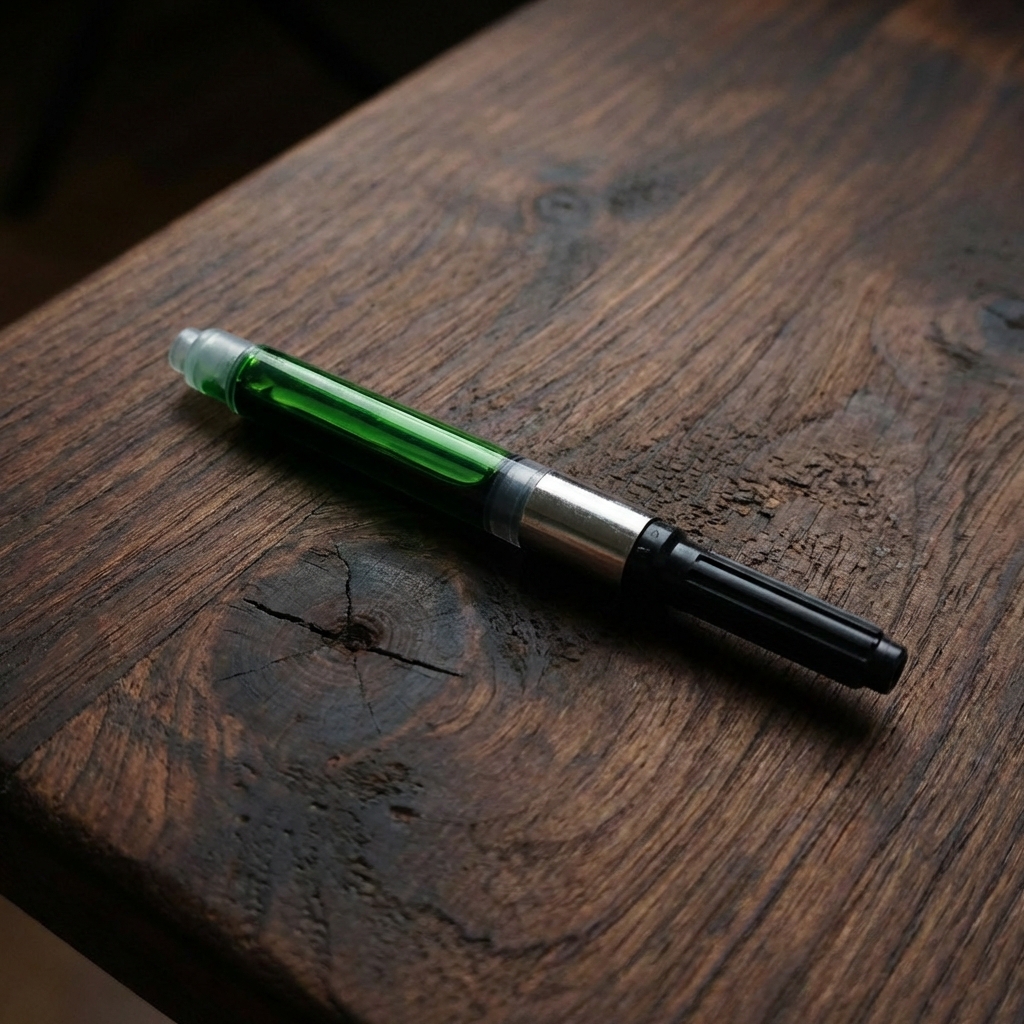
A cartridge is a sealed capsule of ink you drop in, simple but limited to one range of colours. A converter is a small refillable unit that lets the same pen draw from any bottle of ink. A piston filler builds that mechanism into the pen body: it holds more ink, but it cannot use cartridges and is harder to clean. For most people a pen that takes cartridges and a converter covers everything, which is what every Hörner fountain pen does.
The difference, in one place.
All three are just ways of getting ink into the pen. They do not change how it writes, that is the nib's job. They change how you refill, how much ink you carry, and how much choice of colour you get.
Here is the whole comparison at a glance, then the rest of the guide takes each one in turn.
| System | How you refill | Ink choice | Capacity | Found on |
|---|---|---|---|---|
| Cartridge | Drop in a sealed capsule | One brand's range | Small | Most pens |
| Converter | Refill from any bottle | Any bottled ink | Small to medium | Most pens |
| Piston filler | Twist to draw ink in | Any bottled ink | Large | Higher-end pens |
| Vacuum filler | Plunger draws ink in | Any bottled ink | Largest | Specialist pens |
Two of those, the cartridge and the converter, are really the same pen with a different insert. That pairing is what you will find on most fountain pens sold today, Hörner included.
Cartridges: the simplest way to ink a pen.
A cartridge is a small sealed tube of ink. You push it onto the back of the nib section until it clicks, the seal breaks, and the pen is ready. When it runs dry you pull it out and click in a fresh one.
The appeal is convenience. There is nothing to fill, nothing to wipe, and a spare cartridge or two takes no room in a bag. For a pen that travels, or a first fountain pen, cartridges make the whole thing painless.
The trade is choice. A cartridge only comes in the colours that brand sells in that fitting. Most pens, Hörner among them, take the widely available standard international size, so refills are easy to find, but you still get less ink than a bottle holds, and the empties are disposable.
Converters: bottled ink, without the commitment.
A converter looks like a cartridge but it refills. It is a small unit with its own piston that fits the same slot a cartridge would, so any cartridge pen can use bottled ink the moment you fit one.
To fill it, you twist the knob to push the piston down, dip the whole nib into the bottle, and twist back: the piston rises and draws ink up. A quick wipe of the nib and you are writing. There is a step by step in the questions below.
This is the sweet spot for most people. You get the full world of bottled ink colours, you refill for pennies, and you can still drop in a cartridge when you are away from your desk. The only trade against a piston filler is capacity: a converter holds a little less. The Legno and Scriptum come with a screw-in converter in the box, so the choice is already made for you.
Piston fillers: more ink, less flexibility.
A piston filler builds the converter's mechanism into the pen itself. Instead of a removable insert, a piston runs the length of the barrel. You twist a knob at the end, dip the nib, and draw ink straight into the body of the pen.
The payoff is capacity. With no cartridge or converter taking up space, a piston filler holds noticeably more ink, so a heavy writer refills less often. It also feels satisfying, a small piece of engineering you operate by hand.
The costs are real, though. A piston filler cannot use cartridges at all, so you are committed to bottled ink. It is harder to flush when you change colours or clean the pen, since the mechanism is fixed in place. And it usually sits on pricier, higher-end pens. That is why you will not find a piston filler in the Hörner range: for everyday writing and travel, the cartridge and converter pairing is the more practical choice, which the next section explains.
A quick word on vacuum fillers.
You will sometimes see a fourth system: the vacuum filler. Think of it as a piston filler's bigger cousin. Instead of a screw-driven piston, a plunger creates a vacuum that pulls a large volume of ink in a single stroke. Vacuum fillers hold the most ink of any system, but they are the most complex to clean and live almost entirely on specialist and collector pens. For most writers they are good to know about rather than something to seek out.
Which system should you choose?
Work back from how you write, not from which mechanism sounds cleverest.
If you want zero fuss, stay with cartridges. If you want a wide choice of ink colours without the cost or cleaning of a dedicated bottle-filled pen, use a converter and keep a cartridge for travel. If you write heavily in one colour and want the largest reservoir, a piston or vacuum filler earns its keep.
For most people, and for almost anyone buying a first proper fountain pen or choosing one as a gift, the answer is the cartridge and converter pen. It does the job of two systems and asks nothing of you on day one.
The best filling system is the one that matches how you write, not the one with the cleverest mechanism.From experience · Hörner
What our pens use, and why.
Every Hörner fountain pen pairs a German JoWo nib with the cartridge and converter system. You will not find a piston filler in the range, and that is deliberate.
It is the system that fits how people actually use a pen: a cartridge when you want to grab it and go, the included converter and a bottle of ink when you want the full choice of colours. It is easy to clean, easy to refill, and forgiving if you are new to fountain pens. The nib, not the filling system, is where the quality sits, and the JoWo writes a clean line straight from the box.
Start with the converter that comes with the pen and a single bottle of a colour you like. Fill it as described above, and when you want to switch colours, rinse the converter and nib section with cool water until it runs clear, then refill. No special kit required.
Three good places to start, across wood and metal: