How to write a love letter that lasts.
The feeling is there; it's the words that won't come. This guide shows, step by step, how a love letter is built, which salutation and sign-off to choose, and how one concrete memory becomes a letter someone keeps. With templates to adapt and the mistakes worth avoiding.
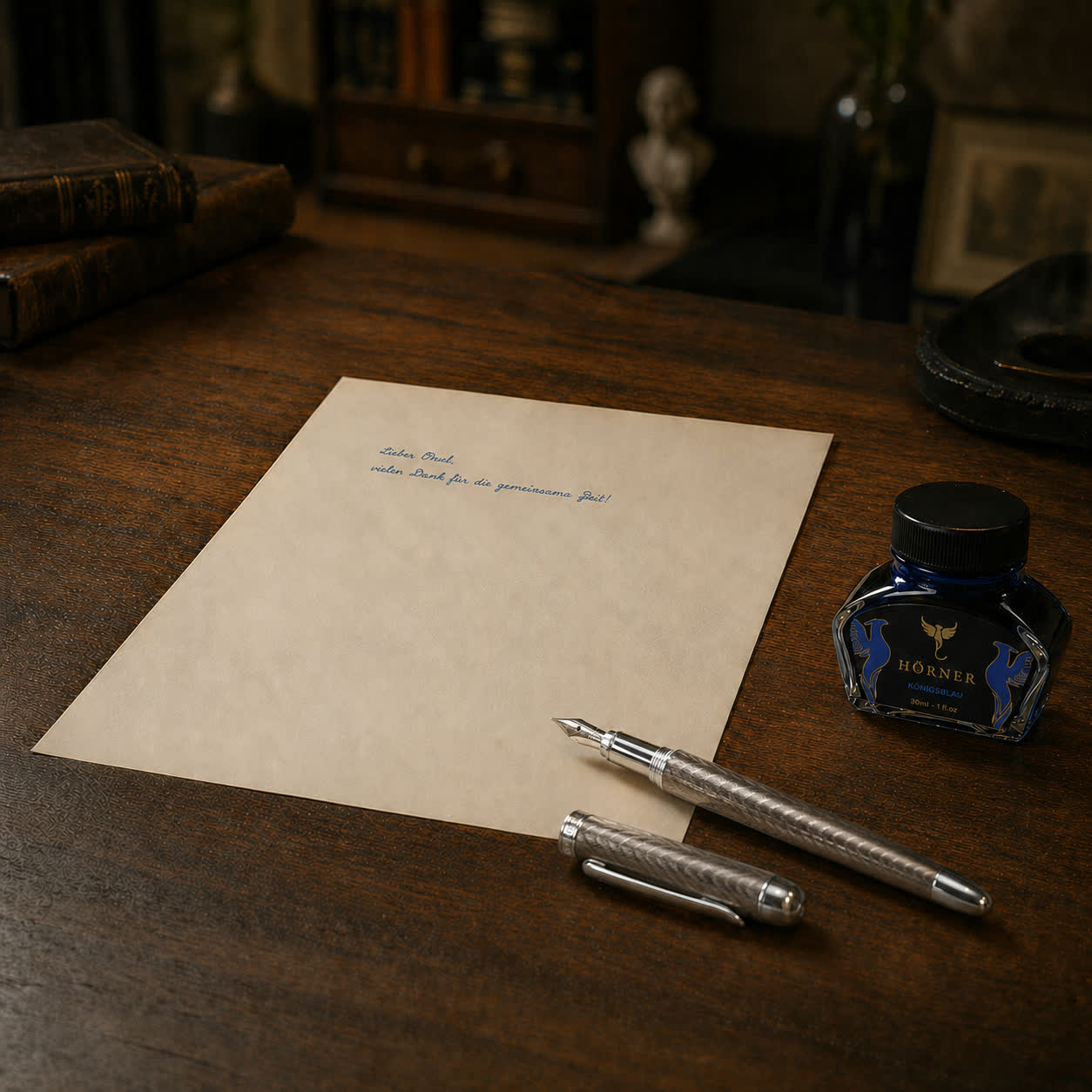
A good love letter follows five building blocks, a salutation, an opening, a concrete heart, a wish, and a sign-off. The heart is what matters: a real memory or a trait that is true of this one person alone lands harder than any grand formula. Write it by hand and in your own voice. Templates, salutations and sign-offs are below.
How do you write a love letter?
A love letter has five parts: a salutation, an opening, the heart, a wish, and a sign-off. The most important part is the heart, and it is built from a single concrete thought: a memory, a trait, a moment that counts only between the two of you.
The most common worry is not finding the right words. It dissolves with one simple idea: a love letter should hold not what sounds beautiful, but what is true. People who think they can't write well often write the best letters, because they stay with the truth instead of the cliché.
| Building block | What goes in it | Example |
|---|---|---|
| 1. Salutation | Personal, with a name or pet name | "My dearest Anna," "My love" |
| 2. Opening | Why you are writing right now | "I'm sitting here and I have to think of you." |
| 3. Heart | One concrete memory or trait | "The way you just took my hand last week." |
| 4. Wish | A look ahead, fitting the occasion | "I look forward to every day with you." |
| 5. Sign-off | A warm closing line | "With love, Thomas" |
The chapters below take each building block in turn. If you would rather start straight away, the templates further down give you a frame you only have to fill with your own words.
The five-part structure.
A love letter follows no rigid scheme, yet the five building blocks give you something to hold on to when you don't know how to begin. Not every step has to be long. What matters is that the heart, the third step, becomes genuinely concrete.
Salutation. It sets the tone. "Dearest Anna" is warm; a shared pet name is more personal still. Begin stiffly with "Dear Anna" and you sound like a greeting card. Reach for the salutation you would actually use when you speak to each other.
Opening. Say why this letter is being written right now. "I wanted to write down for once what I never say out loud" is an honest start. The opening can be small, it only has to be real.
Heart. This is where the letter is decided. Take up one concrete thing: a moment, a gesture, a trait. "The way you laugh when something really delights you" says more than "you are wonderful." The more specific, the more personal.
Wish. A look ahead rounds the letter off. It can be a shared future, a wish for the next time you meet, or simply gratitude for what already is.
Sign-off. A closing line that matches the closeness, followed by your name. The chapter on salutations and sign-offs below shows which ones fit.
Don't write the most beautiful sentence you know. Write the truest one, the one only you could say about this person.Aus der Praxis · Andre Hörner
Templates and examples to adapt.
The templates below are sorted by situation. Don't copy them word for word; replace the brackets with your own names, memories and words. A template is a starting point, not a finished letter. The difference is the one line that is yours.
| Situation | Template |
|---|---|
| A long relationship | "My dearest [name], after all these years I still catch myself looking at you when you don't notice. [Concrete trait] has never become ordinary to me. I'm so glad you exist. With love, [name]" |
| Newly in love | "Dear [name], I haven't known you long, but [concrete moment] stirred something in me I hadn't felt in a long time. I wanted you to know that. Yours, [name]" |
| An anniversary | "My love, [number] years ago today [shared memory]. So much has happened since, and I would choose it all again. To everything still to come. Forever yours, [name]" |
| A long-distance letter | "Dearest [name], the miles between us feel especially wide today. What carries me is [concrete thought]. I'm counting the days until [the next time we meet]. Yours, across the distance, [name]" |
| Making up | "Dear [name], I've been thinking. [What you regret], and I'm sorry. What I don't regret is [the thing you share]. I want to put this right. Yours, [name]" |
If the concrete detail in the brackets is hard to find, work back through the five steps above: one real moment, one trait, one shared memory is enough to build the whole letter around.
Salutations and sign-offs.
The beginning and the ending are often the hardest part, yet there are tried forms for both. You only have to match them to your relationship. The overview below orders salutations and sign-offs by closeness.
| Closeness | Salutation | Sign-off |
|---|---|---|
| Very close | "My love," "My darling," a pet name | "With love," "Forever yours," "All my love" |
| A relationship, close | "Dearest [name]," "My dear" | "Yours always," "Yours," "With love" |
| Newly in love | "Dear [name]," "Hello you" | "Until soon, yours," "Thinking of you" |
| Long distance | "Dearest [name]" | "Counting the days," "Until very soon" |
A common wish is for a sign-off that simply works. "With love" almost always does, from the newest relationship to a long marriage. Put it on its own line with your name beneath. Ideally a concrete last thought stands before it, because the formula alone does not carry the ending.
A salutation lands hardest when it matches the actual relationship, not when it sounds more intimate than the two of you really are. For a new love, a restrained "Dear [name]" is more honest, and so better, than a grand pet name that doesn't ring true yet.
A short love letter and the Valentine's rush.
A love letter doesn't have to be long. Three to five sentences are enough if they're honest. A short letter fits on a card, in a gift box, or on the mirror in the morning. The brevity is no shortcoming, as long as the one concrete line is in it.
When it has to be quick, the evening before Valentine's Day, say, answer three questions for yourself: what am I grateful for? Which shared moment comes to mind? What do I wish for us? Out of those three answers, a letter takes shape in a few minutes. An example:
| Occasion | Example |
|---|---|
| Valentine's Day, short | "My love, in all the everyday rush I sometimes forget to say it: I'm incredibly glad you're here. Especially when you [concrete thing]. Today this note is yours alone. With love, [name]" |
| For no reason at all | "Dear [name], no special occasion, just the thought that I love you as you are. Above all [concrete trait]. Yours, [name]" |
| A note inside a gift | "For you, because [reason]. So you think of me while you write. With love, [name]" |
For the rushed case too, the rule holds: keep one line concrete and even three quick sentences will land. The point is not to fill the page, but to put one true thing on it.
Famous love letters in history.
Anyone searching for words finds, in the famous love letters of history, less a set of ready phrases than the courage to be honest. The striking thing is that none of these letters lives on grand words. They live on real, often very concrete, feeling.
Perhaps the most famous of all came from Ludwig van Beethoven. On 6 July 1812 he wrote the three-part letter to his "Immortal Beloved." It was found only after his death, in his desk, with no name for the recipient. Who she was is unresolved to this day, and that is exactly what makes the letter so moving.
Johnny Cash's birthday note to June Carter, often called one of the finest love letters ever written, says the same in plain words: she still got his vinegar and his fire, and he was still the one she got. Napoleon's letters to Joséphine are quoted just as often. What links them is not their grandeur but their concreteness. That is the part you can take for yourself: don't write grandly, write truly.
What you'd better not write.
Well meant tips into embarrassing fast in a love letter. Usually it isn't a lack of feeling, but borrowed words that don't fit your own voice. The pitfalls below are easy to step around.
| Better avoided | Why |
|---|---|
| "You're my everything" | One of the most worn clichés. It says nothing about this person and reads like a template. |
| Bare superlatives ("the most beautiful in the world") | Without a concrete example behind them, superlatives stay empty and interchangeable. |
| Copied poems or song lyrics | Someone else's words don't replace your own. A plain line of your own lands harder. |
| Too much grandeur | Overstatement tips into the saccharine and comes off as unintentionally comic. |
| Reproaches or conditions | A love letter is no place for settling scores. That belongs in a conversation. |
If no line of your own comes to mind and you feel unsure, stay with the concrete: a moment, a gesture, a thank-you. Three honest sentences about what really happened beat any borrowed grand word.