Are ballpoint pens toxic? Ink, nickel and plastic, explained.
The short answer: a checked pen from a traceable retailer is harmless in everyday use. The longer answer is about licked ink, nickel in the metal you hold, plasticizers in cheap plastic, and how to tell a safe pen from a risky one. This guide separates the worry from the facts, for a US reader.
A normal ballpoint pen from a named, traceable retailer is not toxic. The ink in a refill is tiny and paste-like, so licked ink or a mark on the skin is harmless. The real things to watch are cheap unbranded plastic pens, where plasticizers can live in the housing, and small parts a toddler could swallow. The US has no EU-style nickel-release limit, so for metal pens, sourcing matters. For any swallowed ink, US Poison Help is free at 1-800-222-1222.
Are ballpoint pens toxic? The short answer.
Anyone searching "are ballpoint pens toxic" usually has a reason: licked ink, an inked-up child, a chewed pen. The reassuring news first. A checked ballpoint pen from a traceable retailer is not toxic in everyday use. The amount of ink in a refill is tiny, and deliberately thick so it will not run.
Still, the worry is not baseless. Under the word "toxic" sit three separate things that have nothing to do with each other. First the ink, meaning what happens when it is licked or lands on skin. Second the body material, such as nickel in metal or plasticizers in plastic. Third the small parts and the choking risk for small children. This guide takes all three in turn.
Ink licked or in the mouth? Harmless for an adult, rinse the mouth. Child swallowed ink or mouthed a refill? Stay calm and call US Poison Help, free, at 1-800-222-1222. Ink on skin? Wash off with soap and water. Small part swallowed, trouble breathing? Call 911 right away.
The real risk question is not "ballpoint pen, yes or no", but "checked goods or unchecked bargain import". That is where the US rules, and the second look when you buy, both matter. We come to that at the end.
Ink on skin, licked, swallowed.
The most common reason for the toxic question is ink in the wrong place: on the skin, on a finger, in a child's mouth. In almost every case it is harmless, and the reason is simple.
Ink on skin. Drawing on the back of your hand is fine. The skin takes up almost none of the dye. The only theoretical concern is certain aromatic compounds that could be released from the azo dyes of very cheap inks under constant skin contact. For a checked pen from a US retailer that is not a realistic scenario, and a stray mark certainly is not. Wash it off with soap and water, with a little cooking oil or an alcohol wipe to help.
Ink licked or swallowed. A single refill holds so little paste that licked ink causes essentially no poisoning in an adult. There may be mild nausea or a stained tongue, rarely more. It is different for a small child, or if a whole refill is sucked out or swallowed. Then the simple rule applies: do not guess, call Poison Control at 1-800-222-1222, free and available around the clock.
The deciding factor is the dose. A ballpoint deliberately leaves only a tiny, thick trace of ink, and that is exactly what makes it so low-risk in daily use.From experience · Hörner
One thing belongs here even though it is rarely asked: ballpoint ink is not sterile and never belongs under the skin. Anyone who has heard of "stick and poke" tattooing with pen ink should skip it. The risk there is not the dye but infection from unsterile ink and needle.
Nickel in metal pens, and the US gap.
With a metal ballpoint the question is less about the ink than about what you hold all day. The relevant topic is nickel. It sits in many alloys and is one of the most common contact allergens there is.
A nickel contact allergy is widespread, affecting an estimated 10 to 20 percent of women and a smaller share of men, and once acquired it is permanent. The skin then reacts with redness, small blisters and itching where the metal touches it. So the fair question with a metal pen is not whether nickel is present, but how much of it is released against the skin during normal use.
Here is the honest US difference. The European Union caps that release for items in prolonged skin contact, at a tested legal limit. The United States has no equivalent federal standard for pens. So a US buyer cannot simply lean on a regulator the way an EU buyer can. The practical answer is twofold: buy metal from a named, traceable retailer you can hold accountable, and if you react to nickel at all, choose a wood body that removes the question completely.
This is where it helps that Hörner is a European brand selling on both sides of the Atlantic. The metal pens here are the same models we sell into the EU market, where that nickel-release limit is law under the EU's REACH restriction. They are built to the stricter European nickel standard even though no US rule demands it, so on this point you get the higher bar by default, at no extra cost to you.
You do not have to guess. A wood body sidesteps the issue, because no nickel meets your skin. With metal, prefer a pen from a traceable US retailer over an anonymous marketplace import, and stop wearing or holding it if the skin reacts. The cost of caution here is essentially zero.
Plasticizers and additives in cheap plastic pens.
That leaves the third topic: the plastic. The sticking point is not the ink but the housing of many cheap throwaway and promotional pens. Plastic often needs additives, and some of them are rightly under scrutiny.
Top of the list are plasticizers, the so-called phthalates, some of which are classed as harmful to reproduction and able to disrupt hormone balance. Other compounds such as bisphenol A (BPA) draw similar concern. These additives are not in the ink, but in the soft plastic itself, and they are the real reason to look twice at a bargain plastic pen. Cheap novelty pens have also turned up in testing with traces of lead and solvent residue.
The US has tools here, just not a single pen-specific one. Many writing and art inks carry an ACMI "AP" (Approved Product) Non-Toxic seal, which certifies the product was reviewed and conforms to the ASTM D-4236 standard for chronic health hazards. And pens made or marketed for children fall under the Consumer Product Safety Improvement Act, which strictly limits lead. A plain office pen is not a children's product, so the seal and the sourcing do more work than any single rule.
The plasticizer question is not an ink question. It is decided by the body material. Wood and checked metal never raise it in the first place.Aus der Praxis · Andre Hörner
The practical takeaway is unspectacular: to sidestep the topic, choose a body that does without soft plastic. Which brings us to the material comparison.
Plastic, wood or metal: the material comparison.
Which body is the most carefree from a health point of view? The table below sums up the three common materials, each with its typical weak spot.
| Material | Nickel question | Plasticizer question | Typical weak spot |
|---|---|---|---|
| Cheap plastic | usually none | possible (phthalates) | additives in the plastic, short life, throwaway |
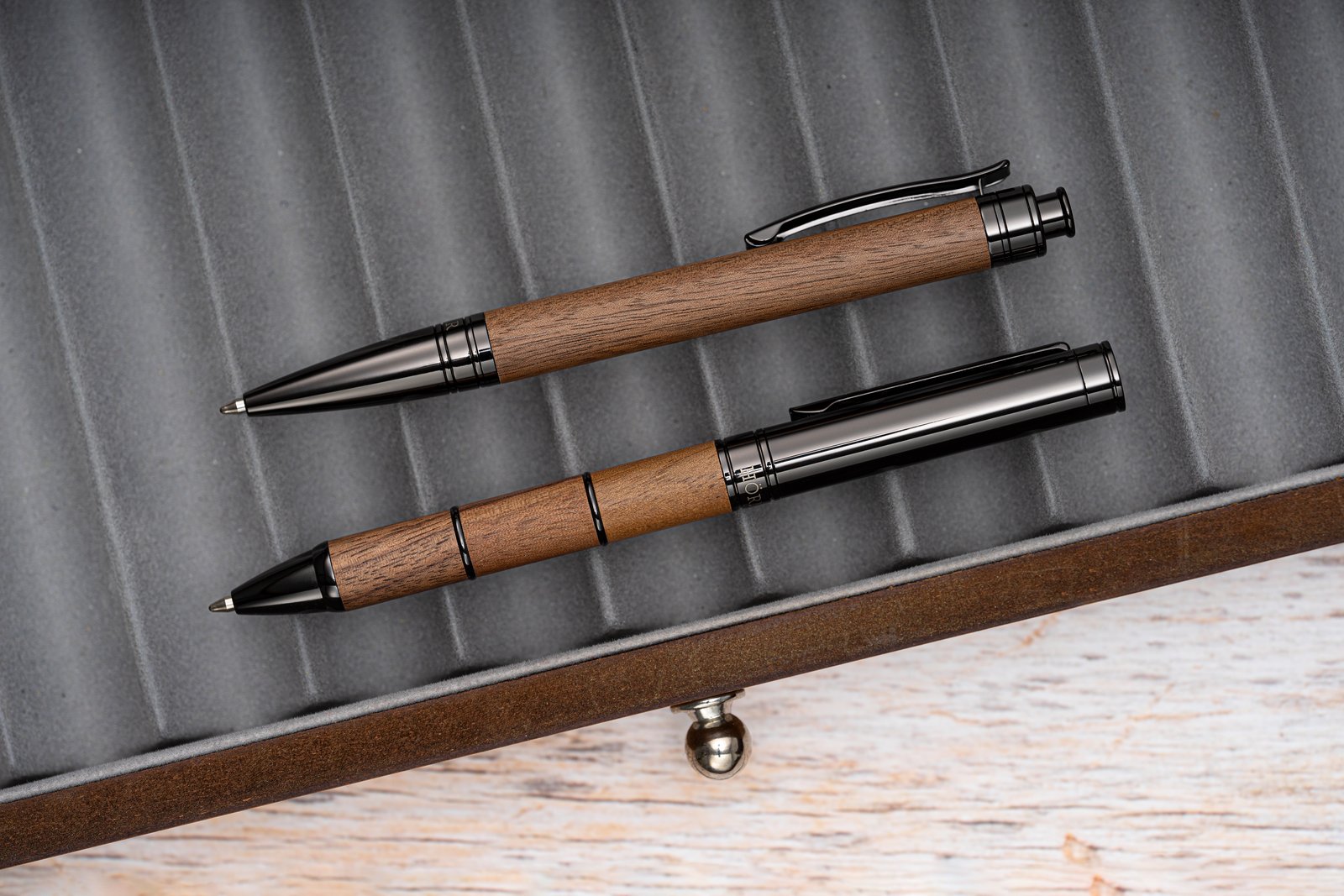
| Wood | none | none | only the metal mechanism inside, no constant skin contact |
| Metal (traceable) | only the nickel release matters; no US limit, so sourcing does | none | cheap, unchecked import alloys |
On pure exposure, wood is the most carefree choice: no nickel against the skin, no plasticizers. Traceable metal is just as harmless in practice and lasts a writing lifetime, as long as it comes from a source you can trust. The one candidate that truly rewards a closer look is the unbranded plastic throwaway, above all as a mass promotional giveaway from an unclear supply chain.
That is not an argument against every plastic pen, but one for deliberate material choice. Anyone who reaches for a long-lived pen anyway has usually answered the additive question along the way. If you are weighing the writing systems themselves, our comparison of a ballpoint versus a rollerball helps.
Kids, small parts and pets.
With children, the real hazard shifts away from the ink. The danger is not the color but the swallowable small parts: cap, refill, clip, push button. Young children mouth everything, and a swallowed hard part can block the airway.
Prevention is simple. Do not give small children take-apart pens, look for a vented cap that keeps an airway open if it is swallowed, and keep writing tools out of a toddler's reach. If it does come to an emergency with trouble breathing, every second counts: call 911 at once.
For a small amount of licked ink, rinsing the mouth and a drink of water is usually enough. For a swallowed refill, a larger amount, or any sign of feeling unwell, call US Poison Help at 1-800-222-1222. Keep the pen handy so you can name the maker and the ink. Do not make the child vomit unless a professional tells you to.
And the pet? If a dog or cat chews a ballpoint, the problem again is less the ink than the sharp plastic shards and the small parts. Watch the animal for cuts in the mouth or digestive trouble, and call the vet if a hard piece is swallowed or symptoms appear. That too argues for a sturdy pen over brittle cheap plastic that breaks into sharp pieces.
How US rules help you, and where the gap is.
Why can you be fairly relaxed about a pen from a reputable US seller? Because there is a framework behind it, even if no single rule covers pens end to end. The Consumer Product Safety Commission can investigate and recall consumer products that prove hazardous, and it enforces strict lead limits on anything made or marketed for children under the CPSIA.
On top of that sits the voluntary but widely used ACMI AP Non-Toxic seal, backed by review against the ASTM D-4236 standard. Between recall power and a recognized nontoxic mark, a checked pen from a named US retailer rests on real accountability, not just a promise.
The gap is not in intent, it is in coverage and enforcement. There is no US nickel-release limit for pens as there is in the EU, and the sheer volume of ultra-cheap pens arriving through opaque marketplace supply chains outpaces what any agency can test. That is the real core of the old rule of thumb, "buy from a retailer you can trace": it is not about country-of-origin romance, but about accountability when something is wrong.
It is also where a brand that sells in more than one market quietly does the work for you. Because we sell the same metal pens in the EU and the US, they are built to the stricter of the two markets' nickel limits. That means the European release limit applies even where no US rule requires it, so on this point the safer standard travels with the pen.
Honesty matters here too. A pen as a whole is rarely a single-country product. At Hörner, the refills, nibs and converters come from German manufacturing, and engraving and final inspection happen in Dresden. The pen itself is carefully selected and bought checked, not made in house. We would rather draw that line clearly than wear a catchy but loose label.
How to spot a pen worth trusting.
Instead of a blanket "buy domestic", a short, checkable list does the job. This is how you spot a ballpoint where the toxic question never comes up.
| Criterion | What to look for |
|---|---|
| Traceable seller | A named retailer with a real contact and address, not an anonymous marketplace import |
| Material | Wood or checked metal rather than soft, cheap plastic |
| Nontoxic mark | An ACMI AP seal or stated ASTM D-4236 conformance on the ink |
| Build | A firm vented cap, no splintering parts, built to last rather than to toss |
| Home with children | No tiny, easily removed small parts within reach of small children |
That is exactly how we shape our own range. The pens we feature here are wood and checked metal rather than soft plastic, built for long use rather than the quick toss. For most people that answers the additive question along the way, with no label sleight of hand.
The bottom line: a ballpoint from a traceable source is harmless in everyday use. The attention belongs to the cheap, unchecked throwaway pens and to small parts in a home with young children, not to the pen on your desk. If you are still weighing which writing instrument suits you, our look at what a rollerball pen is and ballpoint versus rollerball both help.